The Last Minute in the Vending Machine
Page 139 of 196
Chapters
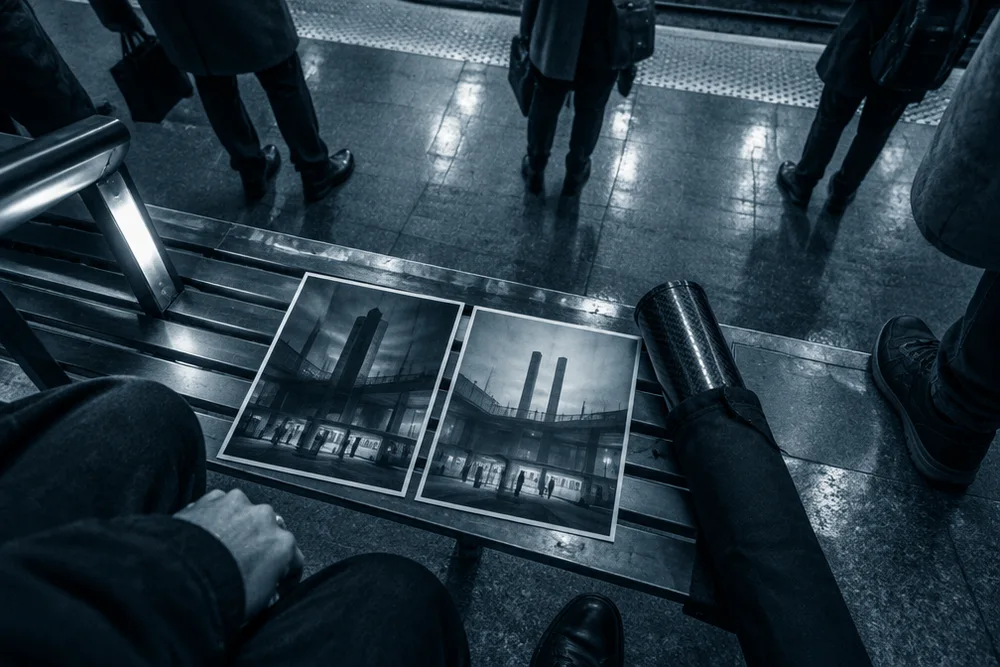
One by one, the other participants came forward. A man with a paper cup chose the watch tagged with his statement; an older passenger in a checked scarf took another. Each received a card, repeated the instruction, and carried both objects upstairs. Miren watched their hands as closely as their faces. The watches were not evidence in the way the carbon was evidence. They were instruments that made a conversion visible.
Ivo took the watch associated with his sister’s statement. He held it in both hands, his broad thumbs away from the crown. The card carried the detail missing from the published version: his sister had looked at the clock above the stairs because the announcement speaker had clicked before the words came through. He had insisted on keeping that sentence in the full account.
“I don’t want anyone to decide this means she could have got clear,” he said. “That’s not what it says.”
“It says what she noticed and where the time came from,” Miren replied. “We’ll keep it there.”
He gave a short nod. On the mezzanine, the first woman was explaining the difference between seeing a clock and hearing a call. The riders were not quiet, but they had stopped moving for a moment. The station’s ordinary rush gathered around the small display without swallowing it.
Tess accepted the watch tagged to the labor-side statement, not one of the passenger accounts. Her card showed the handoff entry from Nella Dain’s dispatch carbon beside the public departure call. The two lines looked almost identical until the column headings were read. That was the point Miren needed people to test, but she had not written an answer on the card.
At the top of the stair, Tess placed the card on the rail and flattened it with her palm. The riders nearest her bent over it. She explained that the recorded time belonged to the public clock, not the crew clock. Her voice was plain, stripped of the defensive edge Miren had heard in the union archive. When the latch held, Tess waited without filling the silence. A minute later, the watch resumed.
A teenager in a dark hood asked why there were two readings if there was one station. Tess pointed to the headings. “There were two clocks,” she said. “One for the people using the trains. One for the people keeping them moving. The conversion sheet mapped one to the other. It didn’t put the missing overlap back on the roster.”