The Last Minute in the Vending Machine
Page 110 of 196
Chapters
She thought of the twelve watches, each held for one minute at a different mark. They could not establish when the derailment happened. Their readings had never been dates. They had made people look again at the statements and ask which clock a witness had used. The object had acquired standing because it pointed back toward the record, not because it replaced it.
“The full-width carbon has a number in the board index,” she said. “The transfer log shows your office received the original series. I won’t call that proof of intent. I won’t call it irrelevant, either.”
Len closed the folder. “Then we disagree about what a correction should cost.”
“We disagree about whether the cost can be hidden in someone else’s minute.”
He left without taking the folder. Its clean pages looked more accusatory than any charge she could have written.
That evening, Ivo Senn met Miren in the public corridor outside the board chamber. The interchange’s windows were darkening, and commuters passed behind them as blurred reflections. He stood with his weight on his right heel, hands tucked into the pockets of his quilted vest. His pressed jeans had a sharp crease that looked too formal for the corridor.
“You found the form number?” he asked.
“A matching entry in the board index. The transfer log says Len’s office received the payroll series intact.”
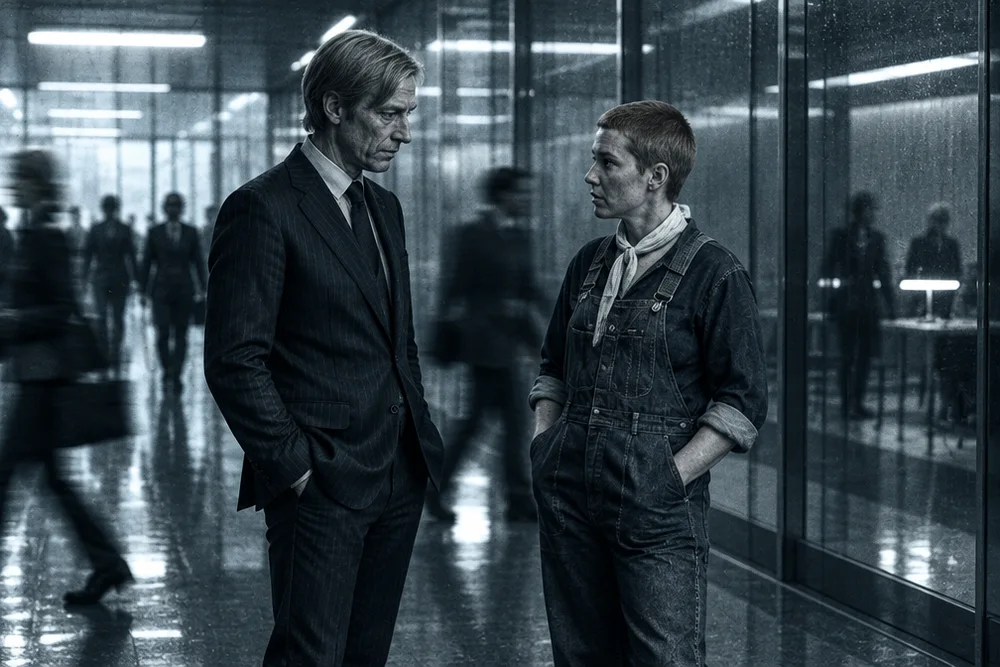
Ivo’s jaw shifted. The cleft in his chin deepened as he pressed his teeth together. “That’s enough to make him produce it?”
“It’s enough to ask the chair to order it. It isn’t enough to say he hid it.”
“You’re still protecting him.”
“I’m protecting the difference between what we can prove and what we suspect.” Miren kept her voice even. “If we overstate it, he gets to make the whole case about our language.”
Ivo looked past her through the glass doors toward the hearing room. His sister’s name was on the official list of the dead, but the public chronology made her death part of a crew-fault finding. He wanted a correction that would survive appeal, not a dramatic sentence that could be dismantled in one paragraph.
“There’s another issue,” he said. “My statement.”
The published version had been shortened. The complete statement included his sister’s private medical detail and a reference to a family argument from the week before the derailment. It also included the small detail he had used to identify it: he had seen the mezzanine clock reflected in a dark window, and the second hand had been caught at the top. The board summary omitted that observation. In the released copy, he seemed to have been away from Glasshook, unable to witness the departure.