The Last Minute in the Vending Machine
Page 107 of 196
Chapters
Miren added the transfer log to the provenance list. A fresh route opened, and with it another chance for the board to claim the original had been lost in transit. The paper’s history was not a straight line. It was a chain of hands, each one capable of dropping it.
They waited while the clerk searched. Tess stood and paced only as far as the filing cabinets, then returned to her chair. Miren used the interval to call the board exhibit office. She did not mention the carbon’s contents, only the form number and the transfer log. A records assistant confirmed that the corresponding exhibit was in the hearing room’s sealed storage, but said she could not release it without Len Orra’s authorization.
“He’ll say we already have the extract,” Tess said when Miren hung up.
“He can say it. We can ask the chair to order the original.”
“And if he says it was lost?”
“Then he has to account for the loss under the same rules as any other custodian.” Miren heard how calm she sounded. The calm came from narrowing the task, not from certainty. She had signed a clock comparison sheet that was now being used as a warranty for a sequence she had never certified. Her own name stood inside this record, whether she wanted it there or not.
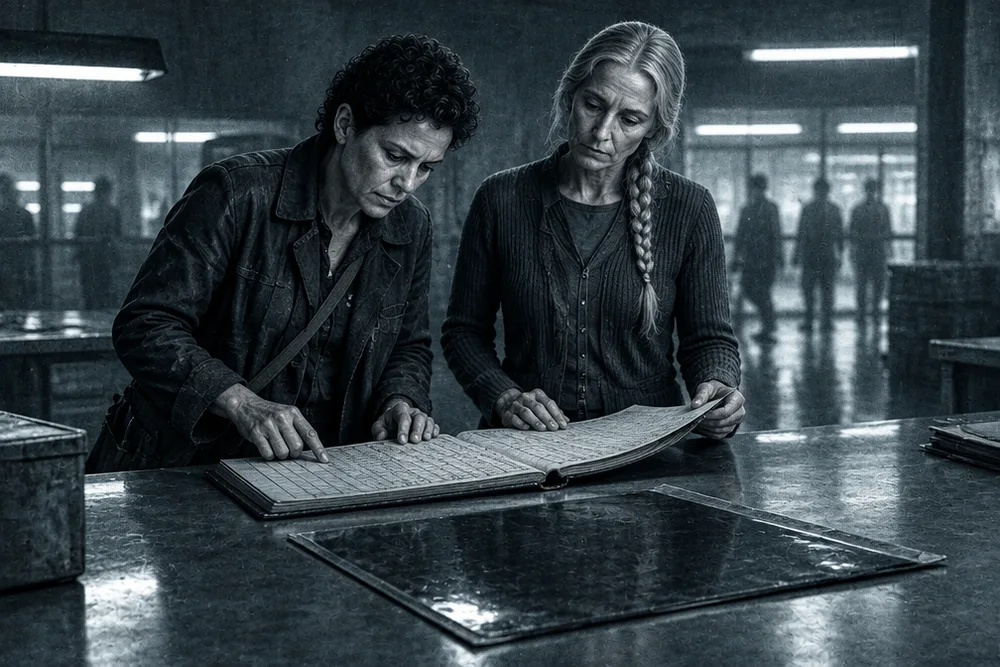
The clerk returned with a thin ledger. He laid it open on the table, careful to keep his fingers clear of the fragile paper. A transfer entry for the payroll series appeared on a ruled page: box count, dates, receiving office, and the initials L.O. The receiving officer had signed for the cartons intact. The line was cramped, but the initials were unmistakable.
Tess leaned closer. “Len?”
“It could be someone else,” Miren said. She copied the entry and noted the ledger’s page number. “We don’t identify initials by wish. The board can identify its custodian.” Still, she felt the first hard click of a mechanism engaging. Len had called the omitted heading an administrative accident, a later clerical simplification. But his receipt put him among the people who had the full records before the chronology was written.
The ledger did not prove he had read this particular sheet. It did prove the original series reached his office intact. Miren resisted the urge to turn that into motive. A chronology could be wrong without a plot behind it. But an error preserved by one person’s signature might stop being merely a mistake when that person defended it.
Tess closed the packet. “If we submit this, they’ll ask why the union kept it quiet.”