The Last Lift Before Rain
Chapter 6 · The Price of Holding
Page 53 of 272
Chapters
“Postpone the release,” Yorin said. “Until after the rain.”
Mera Silt did not look up from the gate schedule. Its corners were pinned beneath a brass weight shaped like a fish, and a thin red line ran from the afternoon column to a block of council initials. “You asked me that in the yard.”
“In the yard you told me no.”
“Here I can show you why.” She rose, taking the schedule with her, and crossed the council room to the narrow door behind the cistern ledger shelves. “If you still want to ask afterward, ask.”
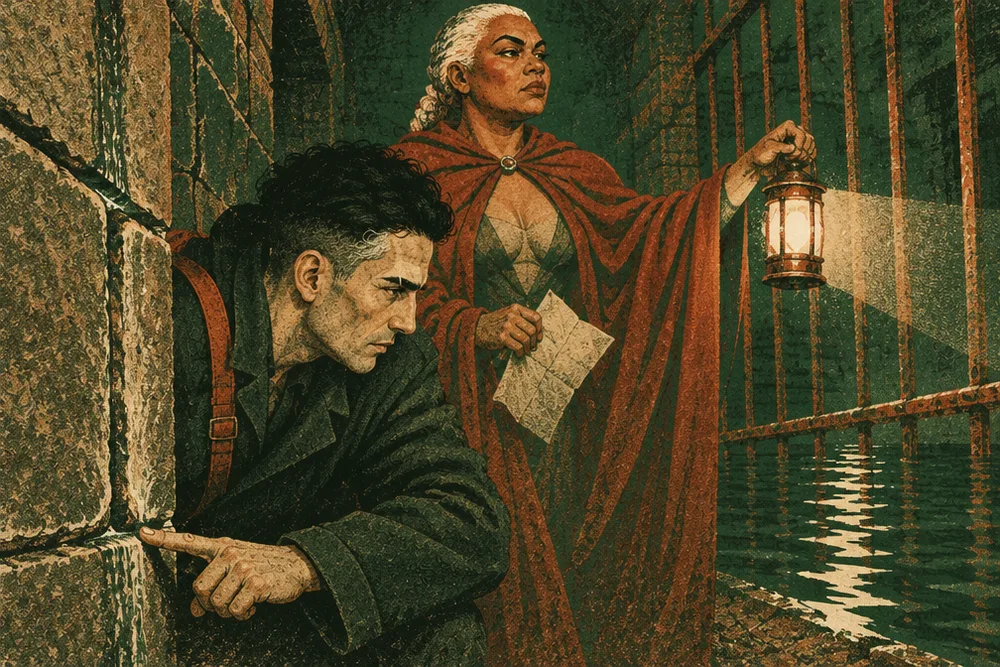
Yorin followed, stooping under the lintel. He had brought the obsolete lift plan rolled in his map sling, but left it there for now. Mera carried a shuttered lamp. The door opened onto a stone stair that smelled of mineral damp and old lime. At the bottom, a grated passage ran beside the ridge cistern. Its water showed through the iron bars, dark and still, with the lamp’s pale reflection trembling across it.
Mera stopped where the passage narrowed. A wet shine marked the wall just above the waterline. It was no broader than a hand, but it ran between two blocks and branched into the mortar below. “That was dry yesterday,” she said.
Yorin crouched. The seep did not bead and fall. It crept, gathering dust at its edges into a soft gray seam. He pressed a finger to the stone beside it. Cold damp touched his knuckle. “How long has the cistern been losing?”
“We have not measured a loss.” Mera’s chin lifted. Her white braid lay against the rust cape like a length of cord. “We have measured the pressure change. The south lining has shifted since the last flood. The release channel keeps the upper basin from loading that wall.”
“And sends the water into the old workings.”
“Into the channel built for it.”
“The channel passes through occupied galleries.”
“The survey says—”
“The survey says what I put on the page.” He heard how quickly the admission came out. He had meant to defend the limits of his work, not hand her a weapon. Mera’s eyes moved to his face, then down to the wet seam. “You mapped registered doors,” she said.
“Yes.”
“Then the cistern is not the only thing we have to decide whether to trust.”
Yorin straightened. In the narrow passage, the map sling pressed against his ribs. He could feel the plan through the canvas: old ink, brittle folds, the lift shafts rendered in confident parallel lines. He had carried it because he thought an old mechanism might offer an alternative to a decision made by the council. He had not yet decided whether that was resourcefulness or delay.