The Last Lift Before Rain
Page 228 of 272
Chapters
Tavin finally met her eyes. “You know what they’ll say if I argue. That I’m protecting my kitchen.”
“You are,” Pella said. “And you’re right to.”
His face softened by a fraction. “Then say it where they can hear you.”
Morning came gray and without a clean edge. The ridge market had opened its doors, but nobody was bargaining over onions or lamp oil. People moved between sheds carrying kettles, blankets, and wet bundles. The vendors had put their goods on higher shelves and their worries in the open. A stack of dry sacks had been shifted to make room for the sleeping families; the remaining sacks were swelling at the seams from damp.
Pella followed Tavin to the broad loading floor where Mera Silt waited beneath the lift head. The steward’s rust cape was buttoned to her throat. Her white braid lay neatly against its collar, untouched by the weather. A clerk stood beside her with a sheaf of papers, and three vendors had gathered opposite, arms crossed or hands tucked into aprons.
“The road camp has heated tents,” Mera said. “There is a ration allotment and a medical wagon. I’m offering a route there before the next weather turns.”
“A route away,” Tavin said. “Not a place to return from.”
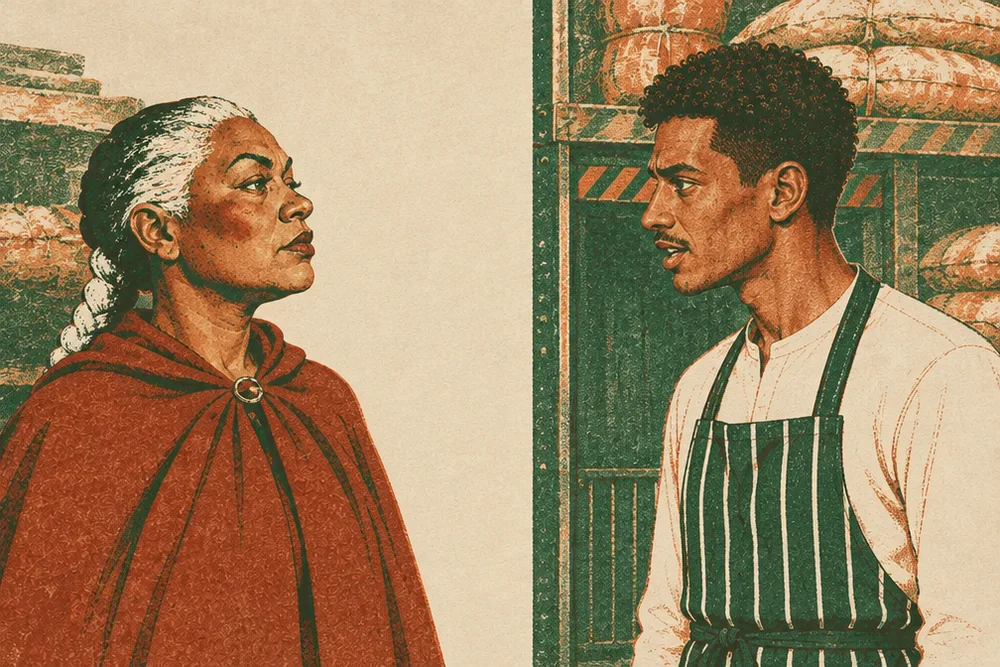
Mera’s chin lifted. “The lower galleries are gone. The council cannot house everyone in its sheds indefinitely.”
“We aren’t asking for the council’s sheds indefinitely,” said a vendor with a flour-dusted sleeve. “My storeroom is full of damaged stock. I can’t feed everyone and replace it.”
“Nor can I leave my carts out in this rain,” said another. “We opened the doors last night. That was not a promise to surrender the yard.”
Pella understood the distinction. Their shelter had been given in the terrible first hours, when the water was climbing and no one could measure what was still safe. Now each person was being asked to turn an emergency into a lasting arrangement. The vendors were not villains for guarding their livelihoods. The families were not ungrateful for refusing to vanish into a road camp.
“We can make a rota,” she said. “Families take turns watching the stock. We keep the central aisle clear for carts. The sheds stay useful to you, and people have somewhere dry to sleep.”
“A rota doesn’t keep damp out of barley,” the flour-sleeved vendor answered.