The Last Lift Before Rain
Page 14 of 272
Chapters
Pella glanced at Tavin. He was listening, though he pretended to be concentrating on the crust of bread in his hand. “There’s work at the ridge,” she said. “The lift yards have reopened. I can pay for a haul when the crate is ready. I just need someone to get it up the path.”
“And how many hands?” Sera asked.
“Two, maybe. It’s a small crate.”
Tavin gave her a look. She heard what she had not said: a small crate, a small favor, a small cost. Down here, every hand had already been assigned a weight.
A scrape sounded from the doorway. A person stood there in a dark work shirt, a narrow face turned half away from the lamplight. They had been carrying a sack; it rested against their leg, one fist knotted in its mouth. Pella had not seen them come in.
“We’ve room,” Sera said, shifting her stool. “There’s stew left.”
The newcomer looked at Pella. Not at her face, exactly, but at the carrying frame by her feet and the brass token in her hand. Their gaze lingered on the stamped market mark.
“I’m not here for a name,” Pella said. She kept her voice low. “I’m Tavin’s sister.”
The person’s mouth moved as if they might answer. Then they lifted the sack and backed into the passage.
Sera did not call them back. She set the spare bowl on the table, turned it upside down, and moved on with the conversation. Pella watched the doorway until the dark shape was gone.
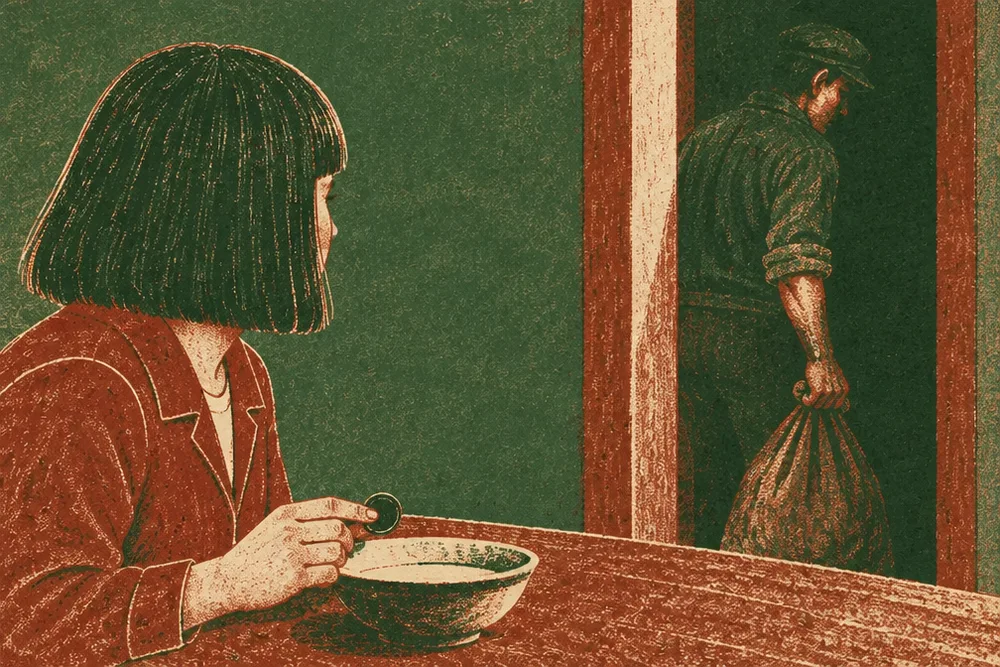
“Who was that?” she asked when the talk returned to the seepage.
“Someone who doesn’t want to be on anybody’s list,” Tavin said.
Pella looked down at her token. “I’m not making a list.”
“You don’t have to. The person who carries it can make one for you.”
“It’s only a market claim.”
“And the ridge keeps records of who buys, who lives where, which doors take deliveries.” His voice was not accusing. That made it harder to answer. “A mark travels.”
Pella closed her hand around the brass. “I didn’t know.”
“That’s why people don’t explain themselves to visitors.” He pulled a splinter from his thumb. “Not because they’re ashamed to be here.”
Heat from the stew warmed Pella’s face. She thought of the hidden doors she had passed, the rooms tucked behind painted stone, the way nobody had asked her to say where she lived. On the ridge, a name was a way to find a person. Down here, perhaps it was also a handle someone else could use.