The Houses on the Roll
Page 44 of 213
Chapters
Mara took a photograph of the drawing’s lower section, checking that the stopcock labels were legible and the rest of the contractor’s notes out of frame. She sent it to Silas. Then she wrote S-14 / S-15 on the delivery slip, underlining the numbers once.
By the time the afternoon light reached the back of the shop, the washer still had not completed its test. The crew’s instructions said the installation was finished only after the cycle drained without a fault. Mara did not know whether the machine itself was sound or whether the building’s pipes were simply not ready for it. She would have to ask a plumber to trace the waste route before she could promise another load.
Inez came past the open shop door carrying an empty blue bag. “Did you get through to your map man?”
“Silas. Yes. He’s looking up the stopcock number in the archive.”
“And the washer?”
“Off.”
“Good.”
Mara nodded toward the folded repair slip in Inez’s hand. “Thank you for letting me read the number.”
“You read it. I didn’t lend it.”
“You’re right.”
Inez tucked the slip into her vest pocket. “I’m going to work. If the pipe does anything else, knock before you touch my sink.”
“I will.”
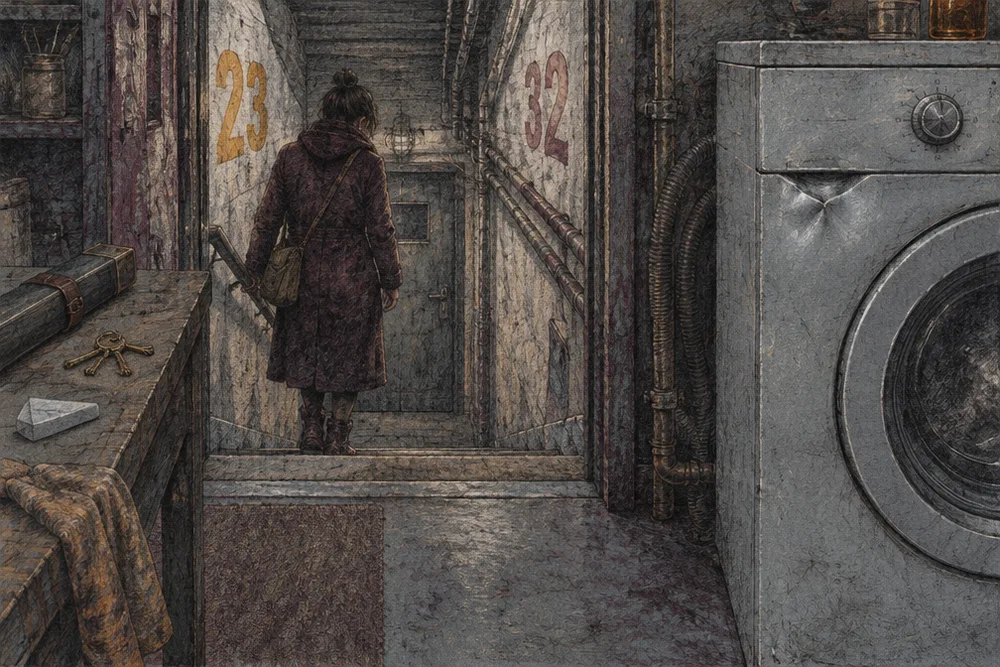
She walked down the steps toward the lower door. The painted numbers faced one another across the passage, contradictory and bright against the rubbed plaster. Mara stayed at the shop threshold, looking at the line the pipes must take behind the walls. The washing machine stood inside, its dented face turned toward her and its hoses quiet.
She sent Silas one more message: “Use S-14 and S-15 as the route. Mailing address is the shop, but it won’t tell you which repair served the flats.” The reply came back quickly: “Understood. Stopcock number is what I need.”
Mara put her phone down. On the cutting table, the service drawing lay beside the delivery slip and the unopened booking book. The shop door was fitted again, though its edge still showed a pale line where it had scraped the jamb. Beyond it, the ridge road carried buses over the old plots. Below, four rear doors waited behind shared pipes and separate lives.