The Houses on the Roll
Page 164 of 213
Chapters
Dev was beside her, shoulders angled toward the exit as if measuring how long it would take to get back to work. His washed-blue bakery fleece had a floury smear at one cuff. Reflective bands circled his ankles. In one hand he held a folded packet, and in the other, a brass key on a plain ring. Silas knew the key from the photographs in Dev’s file, but not the weight it seemed to put in Dev’s palm.
Mara arrived last, carrying no evidence box. The ink-blue apron was gone; she wore a dark coat with a wedge of plum chalk dust caught near one pocket. Her close coils showed the silver patch at her temple. She braced her hips when she stopped beside the others, as if the floor had shifted under her. Her eyes went first to the queue, then to the board, where her signed account had been posted for anyone to read.
“We have the room until four,” Rowan told them. “I’ll take the dwelling references first. Then I’ll consider each household’s file separately. A finding on the plan does not answer the individual claims.”
“We know,” Inez said. “We’ve heard it enough times.” She leaned her chin forward. “We also know there are four doors behind one address. That’s why we’re here.”
Rowan’s pencil tapped once against the form. “Then we’ll keep those questions distinct.”
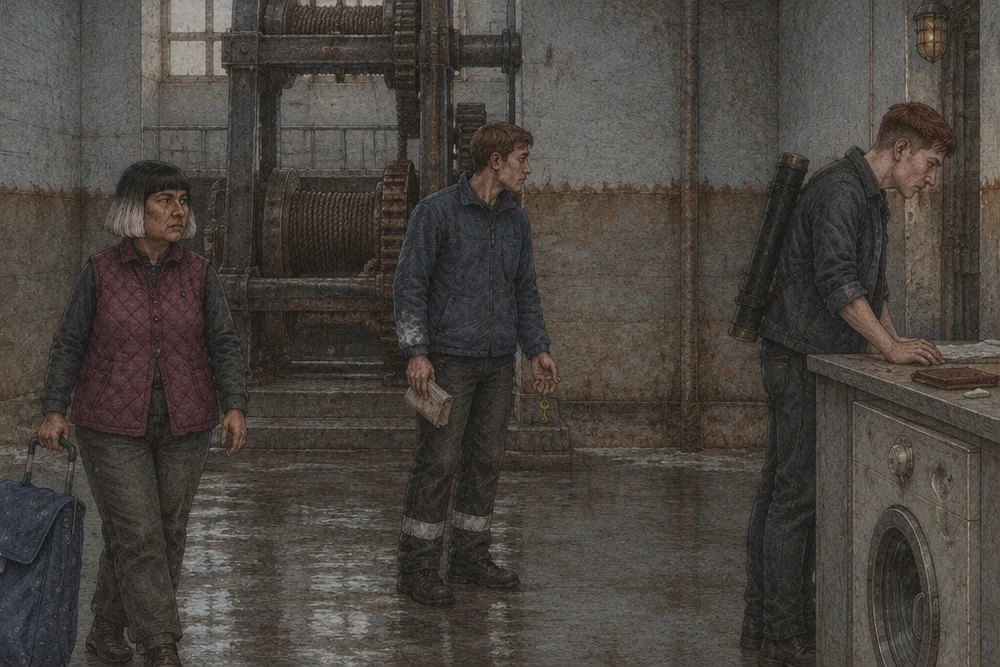
Silas wanted to say that distinct questions were exactly what he had failed to keep distinct when he was a trainee. Instead he lifted the map tube and asked Rowan where she wanted it opened.
“On the table. Keep the annex papers in the booth.”
The review table stood under a long strip light in the center of the hall. Its surface had been scarred by years of metal tools, then covered with a sheet of clear plastic that trapped grit beneath it. Silas slid the map from its tube. The stiff paper resisted at the curled ends. He eased it flat with both palms, careful not to cover the marks that mattered.
The official map showed Tallow Row from the raised bus road side. The shop faced the ridge; behind it, four narrow rectangles had been colored the same dull gray as the storage sheds farther down the block. The doors had labels that seemed orderly until you tried to walk them. One side began at the high end and counted down. The other began at the low end and counted up. Their painted numbers had been applied from opposite directions, a practical arrangement for people living there, a trap for anyone comparing them from a single printed orientation.