The House We Could Move
Chapter 20 · Two Lights Above the Lane
Page 208 of 217
Chapters
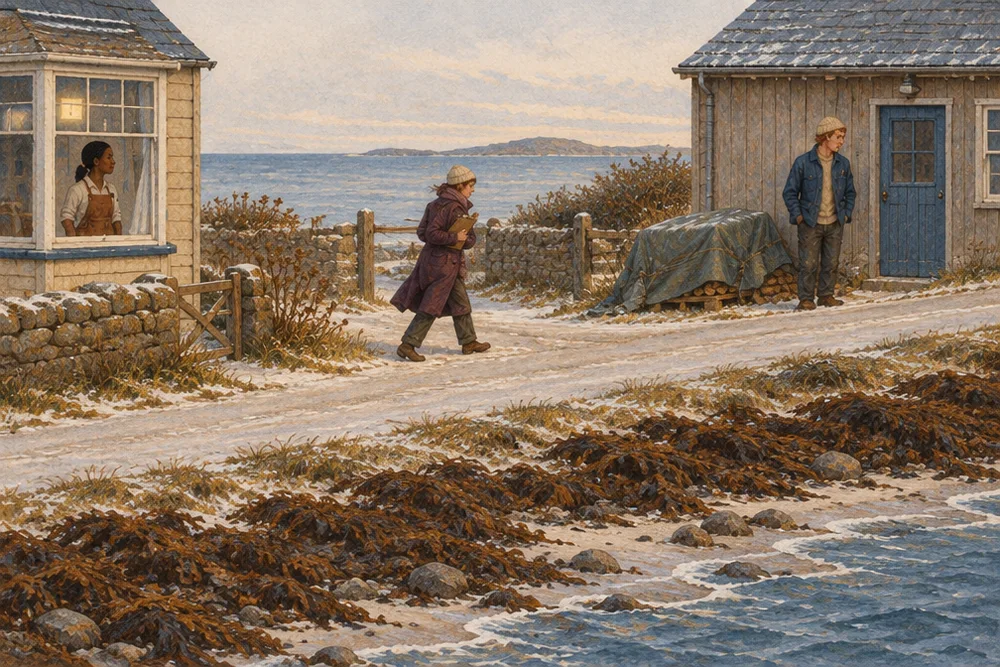
Five months after the house came ashore, the first winter blow left a comb of wrack along Wren Strand and a clean lane above it. Orla stood at her bay window in her socks, watching Mair Venn walk the path with her brass clipboard held against the wind. The porch light behind Orla made a small pale square on the glass. Across the launch lane, Quentin’s cabin stood on the east plot, its roof newly inspected, its door shut against the weather.
Mair stopped at the bend where the path dipped, crouched to examine the packed gravel, then wrote something down. She had insisted on the inspection at first light, before the shellfish crews began moving their gear. Orla knew the order of things now: the public lane first, the launch below, the houses beyond. She had learned to feel the harbor’s timetable even from land.
At the bottom of the strand, Sella Marr’s crew rolled a loaded trolley toward the water. Its broad wheels passed below both homes, leaving the upper path untouched. Sella called up that the lane was clear. Mair answered with a raised hand, then looked to Orla. “No washout. No obstruction. I’ll put it in the log.” Orla nodded. It mattered to hear the result spoken plainly—not as a favor, but as the record of a promise kept.
Mair’s plum cape snapped behind her as she climbed to the landward path. She held the clipboard flat against her chest and checked the winter waterline against the marked stakes. The path stayed open; the west shelf stayed above the reach of the blow. Orla stepped outside, cinnamon apron tied over her clothes, chalk still blue on her thumb from an early repair for a customer.
“You’ll want the east plot’s drainage checked again in spring,” Mair said. “Not because I doubt the inspection. Because the first winter is when we learn what the paperwork missed.”“I’d rather learn it now than pretend the paper’s magic,” Orla said. Mair’s mouth twitched, almost a smile.
Quentin came out of his cabin carrying a folded tarp. His rust curls were flattened by his oat knit cap, and his ink-blue coat flapped at the hem. He had spent the night there; the cabin’s first winter inspection had been completed the previous week. The place was still spare, but it was his, with its own steps and its own door. He set the tarp over a stack of kindling, then joined them on the path.