The House We Could Move
Chapter 14 · The Ruts After Market
Page 143 of 217
Chapters
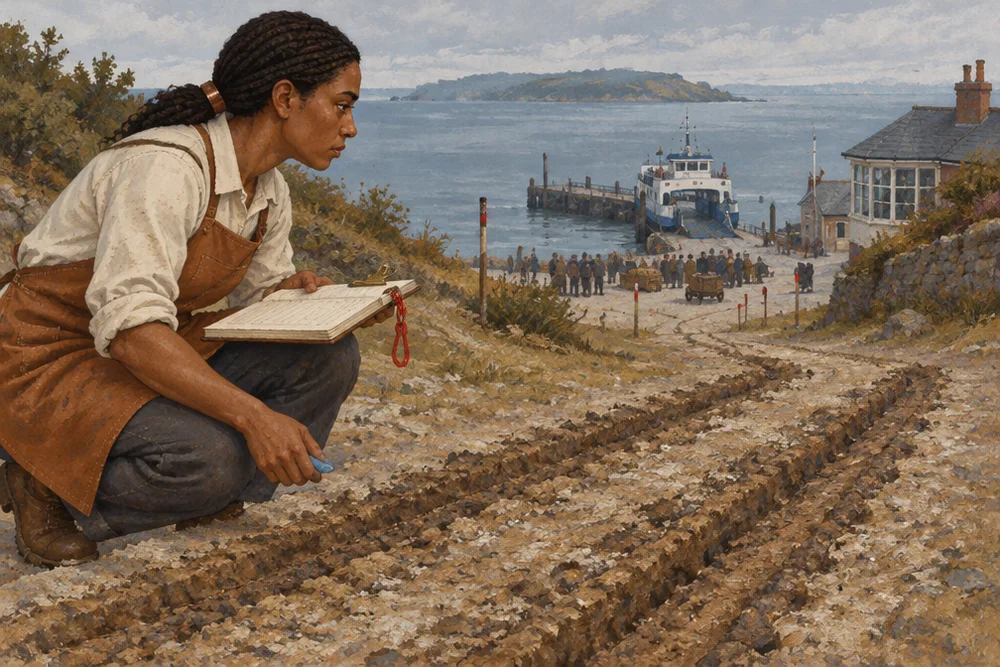
The daytime trial had been quiet until the market let out. By then the tide had turned, and the beach below Wren Strand was full of the small, practical noises of a working harbor: trolley wheels clicking over stones, gulls arguing over a dropped mussel, the slap of water against the cooperative’s launch ramp. Orla stood by the marked upper path with her ledger tucked beneath one arm and watched a pair of market porters try to steer a handcart around the house’s temporary landing stakes.
They took the turn too wide. One wheel dropped into the soft edge of the path, and the cart’s weight dragged it sideways. The porters hauled it back, leaving two fresh ruts that ran from the landing lane toward the landward track. The cart had not touched her house. It had not touched the proposed steps. Still, Orla felt the sting of being the obvious new thing in the way.
She wrote the time in the ledger: half past three. Then she added the cart’s direction, the condition of the ground, and the fact that the porters had chosen the upper track rather than the firmer route below. She had learned that a useful record described what happened, not what she feared it meant.
“You’ve got the face you make when a hem’s gone crooked,” Ivo said behind her. He was carrying the collection rail back from the baggage loft, red key loop bouncing at his hip. “Is it fixable?”
“I don’t know yet.” Orla crouched to measure the rut with the end of her pencil. Blue chalk smudged her thumb against the wood. “I need to know whether this is because the house is here or because people keep using the path as a shortcut.”
“Could be both.” He set the rail down beyond the marked route. “That’s why they asked for a trial, isn’t it?”
The question was fair. It did not make the churned earth less real. Orla looked toward the west shelf, where Bell Basin’s pale ferry-office walls showed above the waterline. Its bay window faced the path now, as she had chosen. A view could be given up on paper. A path, she was learning, had to work under other people’s feet.
She found the market porters at the lower landing, returning their empty cart to a stack beside the cooperative’s baskets. One was a narrow man with a red scarf tied around his cap; the other had a shoulder wrapped in a wool blanket despite the mild afternoon. They stopped when Orla called to them.
“I’m recording traffic on the upper path,” she said. “Could I ask why you took the cart that way?”