The House We Could Move
Page 205 of 217
Chapters
“Do you want help?”
She considered him. “You can carry the folded mattress from the loft. Just that. I want to set everything else myself.”
“All right.”
He carried the mattress because she had asked, not because he could think of a better use for his arms. The old baggage loft smelled faintly of pressed cloth and dust. Orla had already packed her first-night things in two canvas bags: a change of clothes, a kettle, a cup, a tin of tea, the receipt, and a small lamp.
“You’re taking only one cup?” he asked, lifting the mattress edge.
“I’m taking one person’s things.”
There was no sting in it. She was telling him what she had decided, and he let the fact remain hers. They carried the mattress to the ferry office and slid it through the doorway. The cream tiles had been scrubbed clean of the last tide’s salt. The bolted cutting table still stood where it had always stood, but the space around it had changed; the house had been stripped of loose things before the tow, then furnished again little by little.
Orla chose where the mattress would go, then moved it twice. “There. If I put it nearer the window, the draft will keep me awake.”
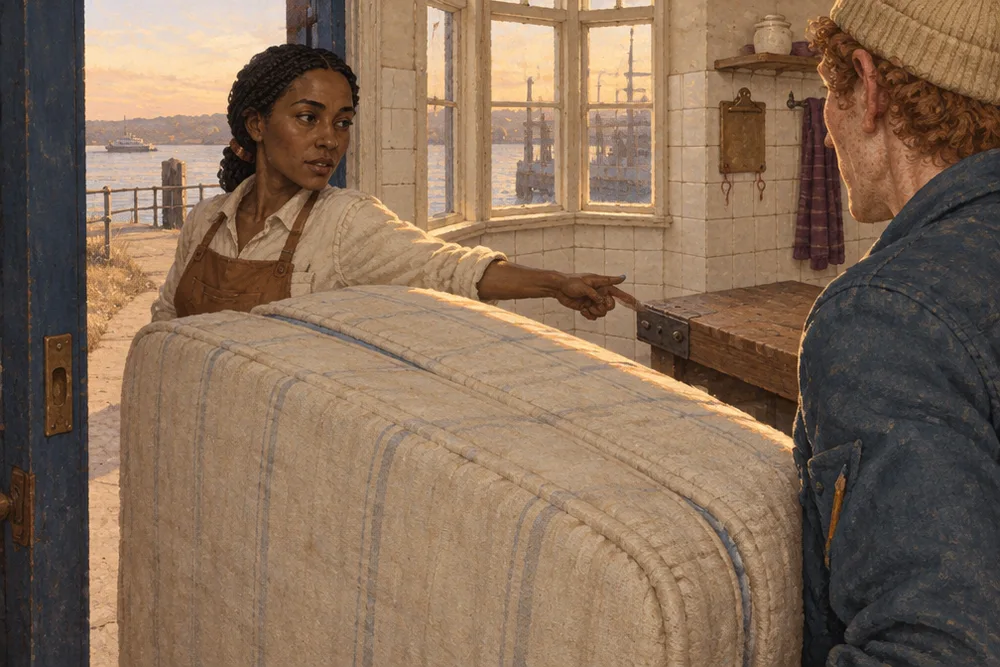
“The window catch is secure.”
“I know. I still don’t want to sleep in a draft.” She set down the lamp. “You can go when you’re ready.”
He looked at her. “I’m not in a hurry.”
“I am.” She smiled, and the distinction mattered. “Not to get rid of you. I want the first night to be mine.”
“Then it will be.” He carried the empty canvas bag back to the loft and left her to arrange the room.
He spent the remaining daylight at the east plot, checking each temporary brace against the inspection list. The cabin was small enough to seem almost provisional, though every joint was fitted to last. He ran a thumb along the roof seam and found no lift. The door opened cleanly. Its latch was new, plain, and his to use if the board approved the dwelling.
From there he could see the bay window of Orla’s house. A warm light appeared inside. He could make out her moving shape as she set the kettle on the counter, then crossed the room carrying something small. He did not know whether she had noticed him looking. He turned back to his work.