The Hall of Borrowed Hours
Page 6 of 251
Chapters
“Not yet,” she said. “For now, do what you can do without losing your own turn.”
Pera gave a short nod and settled the child beside her basket. He watched the water with grave concentration.
The first wash ran through its allotted hour. Yvonne marked the start and end, though the boiler had not yet reached its full heat. She noted the fuel and crossed out a line where she had first written the wrong mark. The woman whose turn followed saw the correction and waited without complaint.
It was a small success, the kind that could be lost by a careless word. Yvonne kept the ledger open and her hand on the page.
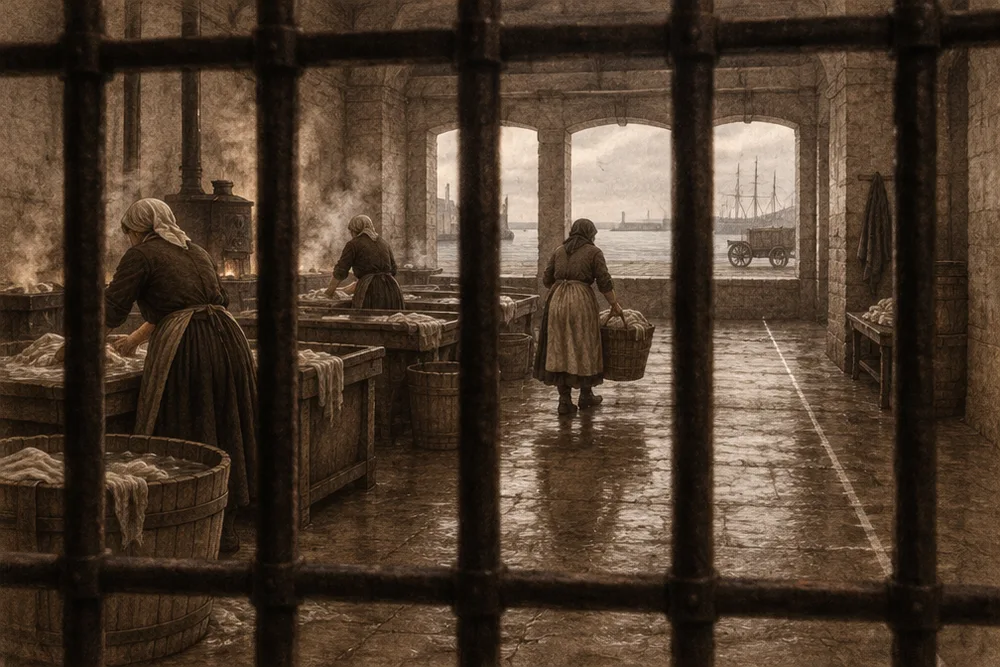
By noon, steam had softened the damp on the walls. The women worked in a rhythm that was not yet a rhythm: carry, sort, heat, scrub, wring, rinse. The inspection grille made a dark pattern across the gallery, and outside it the port kept moving—cart wheels, gulls, the slap of water against the quay.
Yvonne stayed near the ledger and the boiler. When a hotel porter asked for another turn, she showed him the written slots. When a woman arrived with a basket after the time marked beside her chosen cross, Yvonne asked whether she wanted the next opening or wished to leave the bundle for tomorrow. No one had to plead a reason.
“Tomorrow means another day without clean shirts,” the woman said.
“The late turn may open if the heat holds.”
“May?”
“I will tell you when I know.”
It was not the answer anyone wanted, but it was true. Yvonne had learned that false certainty cost more than a refusal. The trouble was that a refusal could look exactly like another person’s convenience.
Mara had not played again. She sat on an upturned crate, tightening a peg while the others worked. The pale nick at her violin’s chin rest caught a sliver of light whenever she turned it. A boy who had wandered in from the arcade watched her hands. She let him watch without handing him the instrument.
The engineer’s chalk line remained untouched. Yvonne checked it twice, though no tub had come near it. Keeping the boundary was not the same as knowing whether the room was safe; it was simply the first promise they had been given, and the one they could keep.