The Hall of Borrowed Hours
Chapter 17 · The Blank Price Beside a Song
Page 200 of 251
Chapters
The morning after the bids were heard, Yvonne found a new notice on the Weights Room door. The council had called the bidders back before the vote. It would not hear the offers again. One question stood above the hour: What does the town receive in return for rent below the private offer, and what can it require if the receipts fall short? Beneath it were the fuel account and the revised schedule, named by their exhibit numbers. The ink had run where the night’s damp had got under the paper.
“They ask what we give them,” Dina said. Her tin lunchbox knocked against the stair rail as she shifted her shoulder through the press. “As though a person who can only wash at noon has received a bargain.”
Yvonne read the notice once more, then took the stairs up to the chamber. The public scales stood below, their iron arms motionless. Beyond the high windows, the harbor was a colorless strip between roofs. In the Weights Room, men were arranging chairs around the council table. A clerk had set a water pitcher beside the chair reserved for the bidders. Yvonne’s fingers found the darned white cuff at her wrist. They were asking for a price beside something that had never been sold.
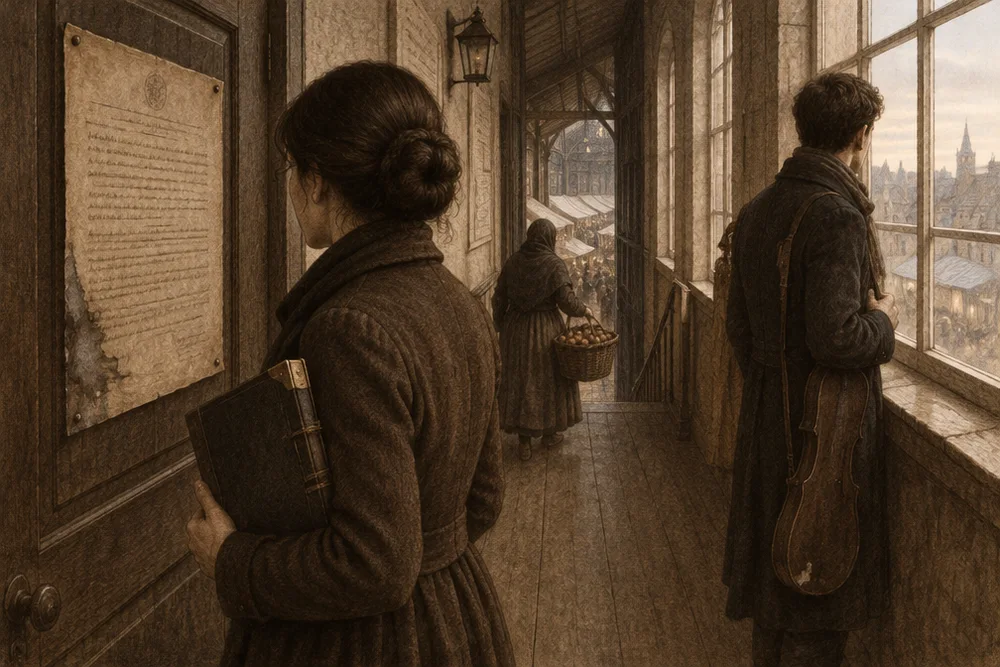
The women waited in the corridor with their papers and their coats still damp at the hems. Pera held the folded sleeve she used to shield names in the ledger. Mara’s violin case leaned against the wall, its pale chin-rest nick visible where the lid did not quite close. Yvonne had brought no instrument, only the brass-cornered ledger and the fuel receipts tied with string.
Leone stood apart near the window. His long ink-brown coat hung straight; the bright key ring was gone from his belt. He was no longer the clerk who could quietly open a door. Suspended from copying duties pending review, he had come as a witness, and he kept his hands clasped behind his back as if the old habit of touching papers might be mistaken for authority.
“You have your statement?” he asked Yvonne.
“The figures and the parts they don’t measure.”
He nodded. “Keep them separate.”
“I know.” She did not tell him that she was angry he had to remind her. The ledger had survived a councillor’s inspection and a safety closure, but every time it opened in public it risked becoming a different kind of book. She had let the women record hours between loads because those hours explained why a wash got finished or why somebody missed a turn. Now the council wanted to know what the town received. The distinction between explanation and price would have to be spoken aloud.