The Hall of Borrowed Hours
Page 172 of 251
Chapters
“When?” Leone asked.
“Tomorrow, if they can persuade the first household group to soak ahead of the turn.” She took her lunchbox from the landing floor. “I have to ask them. I don’t have the authority to give away their time.”
Pera followed, her paper sleeve tucked close to her vest. “And the booking rule is still unsettled.”
“They’ll test a spoken booking with a witness,” Dina said. “We’ll see if that works. If it doesn’t, we tell them so.”
Mara tilted her head. “No one has asked for a song?”
“Not today,” said Pera.
“Then I’ll keep mine.” She lifted the case by its handle and headed down the steps.
The stewards had not fixed the bid. They had made a test, and given the test back to the people who would live by it.
Leone walked with Dina as far as the crossing. The wind had risen from the harbor, driving salt grit along the gutter. She kept one hand on the lid of her lunchbox, as if the latch might open under the jostling.
“They’ll ask you to come tomorrow?” he said.
“They have.”
“Will you?”
“I have to know whether the wash can finish before I go back.” She glanced at him. “I also have to be paid for the time I spend helping them find out.”
“You should tell them that.”
“I did.”
At the crossing, Dina turned toward the boardinghouse street. Leone stopped. He did not offer to accompany her or claim that he had understood all along. Her shoulder led her into the crowd, and then she was gone between a handcart and two women carrying baskets.
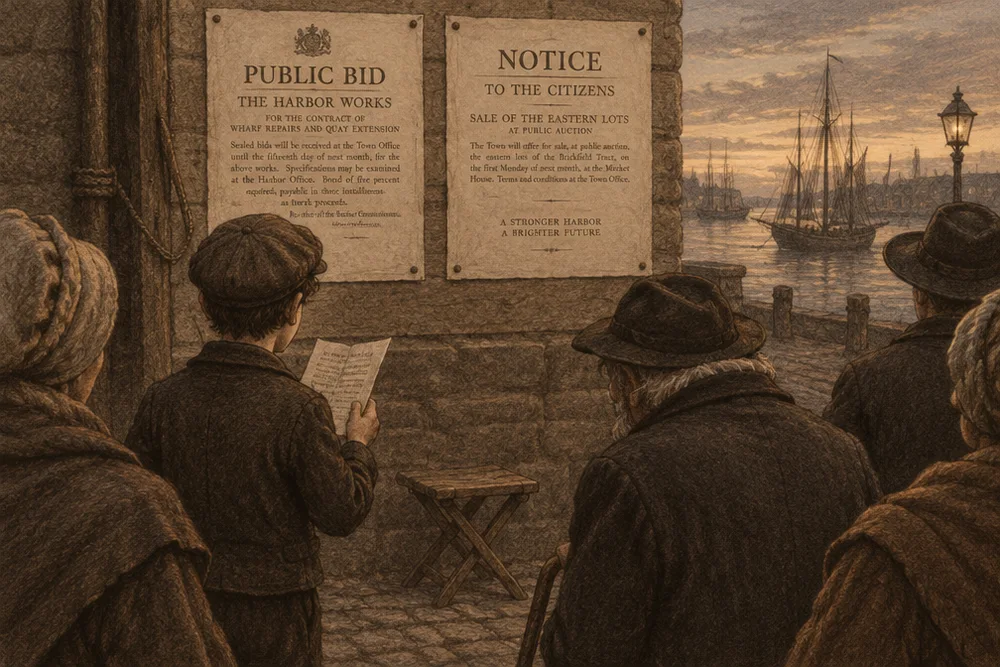
He returned to the market stair. The notices were still there, their corners now weighted by fresh pins. Below them, the porter had set a stool for those who needed to wait. A boy was reading the public bid aloud to an older man who could not see the small print. The boy stumbled over the clause about bond installments, corrected himself, and began again.
Leone stood at the edge of the landing while the words passed down. A public room, a fixed rent, a commercial trial, a household session, an exit route. Each phrase seemed plain until somebody tried to use it.
At the bottom of the stair, Radan spoke with two merchants who had come to inspect the numbers. He could promise wages and predictable rent. The stewards could offer a different kind of guarantee: no one’s help would be counted as payment, and the people who used the room would set its rules. Neither promise had been proved.