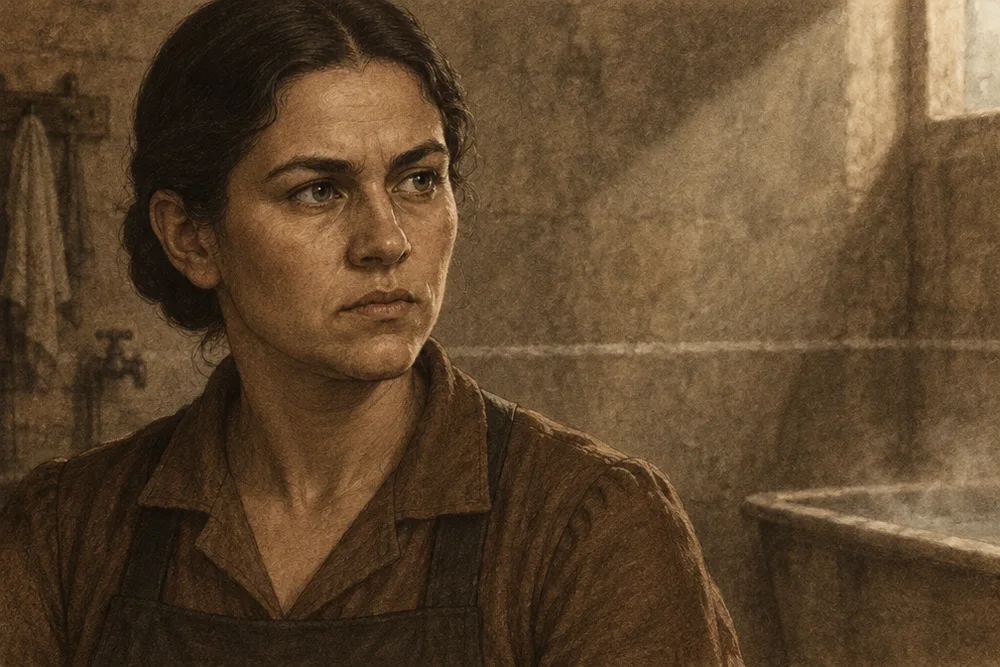
The Hall of Borrowed Hours
Page 129 of 251
Chapters
The words landed. Yvonne was used to thinking of herself as the one who had to be here: tending the boiler, keeping the chalk boundary, refusing a hotel foreman who wanted one more tub. But that work had given her the authority to set the day’s shape. “You are right,” she said. “I am here because I can make a living from this room. You come between two shifts. We must not make the timetable from my day alone.”
Dina’s shoulder lowered a fraction. “Then put down the time I can come.”
Yvonne took the chalk. She wrote dusk on the back of the notice, then drew a line for the length of a washing turn. She did not give the hour a name yet. The actual clock varied with the season and the work; a fixed end mattered more than a grand label. “A reservable turn in the evening,” she said. “The first proposal, not the final one.”
Pera leaned over the chalk marks. “And no one pays by leaving a name in that other book.”
“No,” Yvonne said. “The favors do not buy a place.”
A woman at the tubs began to speak, then stopped. She had come with two bundles and a child who had been coughing through the morning. “If I cannot pay the full charge?”
Yvonne looked toward the ledger. She could hear the boiler settling, a metal knock followed by a soft rush of steam. The charges were not settled; the bid would have to include them. She had spent years refusing customers who expected a laundress to take less because they had asked prettily. Yet a public room could not be only another place that turned away the poor. “We need a way for a woman to give something in place of a fee,” she said. “A favor, perhaps. Watching a child, mending a shirt, carrying water.”
Pera’s expression hardened. “You mean a woman must work to wash her clothes?”
“I mean she should not be turned away for a coin she does not have.”
“And if she has no child to watch, no needlework, no strong back to carry water?” Pera tapped the table once. “Then she owes us because she is poor?”
“That is not what I mean.” Yvonne heard the sharpness in her own reply and forced herself to stop. She had offered the idea because it seemed generous. But an obligation could wear the face of generosity and still take something a woman had not chosen to give.