The Empty Seat at Low Tide
Page 168 of 257
Chapters
Della set it on the counter, looked at it and picked it up again. “Not this. This makes it look as if you canceled.”
She brought out a piece of terminal letterhead instead. Carys read the laundry’s reference aloud while Della wrote it down. The woman gave her surname and the number printed on the carton. Della bent to check the number against the one she’d written. Her coat touched the wet wheel, leaving a dark half-ring on the hem.
She read out what she’d put: the carton had been presented that morning and had not been accepted; the terminal was not receiving freight for Monday’s advertised crossing. No charge had been made. Then she added her name and the time from the hatch clock.
“Will that stop them charging me?” the woman asked.
“I don’t know what your agreement says,” Della told her. “It gives you something from us to send them.”
The woman read it herself. She put the letter inside the delivery sheet so the dry fold covered the new writing. “Right,” she said. She didn’t thank either of them. She was working out how to get the loaded wheels back over the sill.
The trolley would have been easy to push out empty. Loaded, it caught on the metal strip across the doorway. Carys went outside and pushed the mat back with her heel while the woman brought the wheels up to the lip. Together they got it over without dropping the carton. On the sloping pavement the woman turned the trolley to face uphill and rested the handles against her thighs.
“I could leave it in my van at home,” she said. “It can’t get any wetter in there than it has down here.”
Carys checked the sagging corner. The carton was still sound enough, but the webbing had worked down the wet side and would slide farther if the woman hauled it up the hill like that. They stood the box flat for a moment and moved the strap over. Once the weight was back on the plate the woman gave it a sharp pull to check it.
“Is it the boat, then?” she asked.
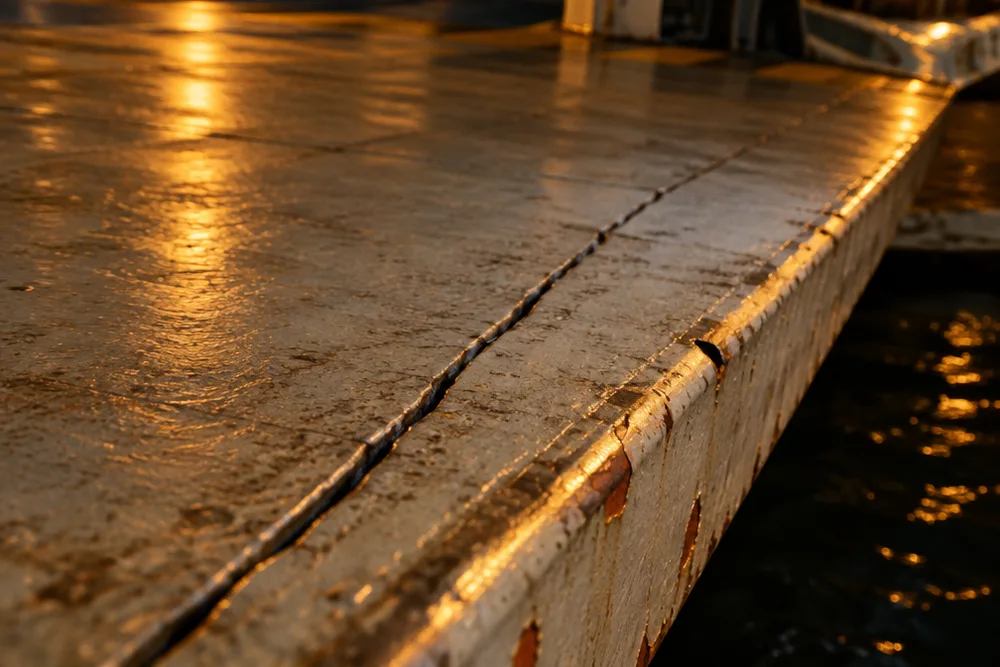
“It’s the loading ramp.”
“But the boat could take people.”
“Not over that ramp.”
The woman looked through the railings. From the road the ramp looked as it always did between sailings. Near the join was the small pale crescent where the paint had gone. Carys had known that mark through different coats of paint on the gate and two winters of people asking which week the ferry would start again. It wasn’t the crack. A person looking from here would have no way of knowing what to look for.