The Candle Map of Quarter Street
Page 176 of 188
Chapters
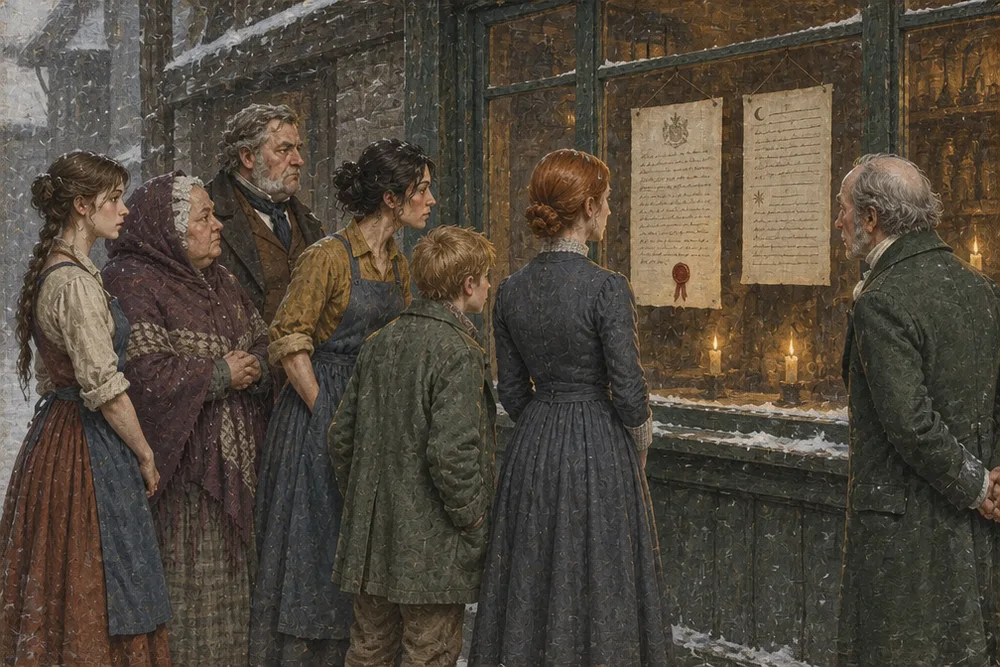
When Wren had gone, Pike carried the ruling to the door and fixed it with two tacks beside the shop license. He used a small hammer from beneath the counter. Each blow sounded too loud in the emptied room. The notice hung square, the fine and closure written in Wren’s careful hand, the shop’s continued license stated beneath them.
Edith folded the schedule once, then opened it again to flatten the crease. “You said beside it.”
“I did.” Pike moved half a pace along the wall. He set the schedule there, leaving a hand’s breadth between the papers. “Not under it.”
She held one tack while he drove it in. The printed hours stayed level. No names appeared on the sheet, no houses to be sought out, no promise that the light in one kitchen meant a stranger could cross its threshold.
Outside, a woman stopped to read the ruling. She leaned close to the glass, one finger following the lines. When she reached the schedule, she leaned closer still. Then she continued down the street without coming in. Edith did not know whether she had recognized the room, or merely the words.
Pike returned to the counter. “The first rent for the mending room falls due in a fortnight?”
“Yes.”
“And you will still work here?”
“If you still have need of an apprentice.”
He looked at the ledger and then at her. “I have need of someone who can count.”
“Only the books?”
“The books first.” His expression softened by a degree. “The rest will have to be learned as we go.”
The answer was not the promise she had wanted at the beginning of the week. It was less, and more difficult to rely on. Edith went to the rental press and checked the lock. The stock was in order. The account lay open to the declared loss, the page bearing the name she had not written. She shut the cover carefully.
“I thought an inspection would mean proving there had been no mistake,” she said.
“There has been a mistake.” Pike rubbed one thumb over the brass button at his waist. “There has also been a count.”
“And the old branch?”
“Closed.” He glanced toward the two papers on the wall. “That is not nothing.”
Edith looked at the schedule. The room would be small, and two evenings were fewer than the promises the volunteers had first made. The door would open only when someone was there to keep it. But the paper did not pretend otherwise.
“No,” she said. “It is not nothing.”