The Block Beneath the Fold
Chapter 9 · Three Painted Windows
Page 115 of 286
Chapters
Mara asked him before she told Len. They stood in the spare room with the working drawing spread over the bed, its corners held down by a spool of thread, a chipped mug and Ivo’s green tally pencil. The room had been prepared for inspection: the bed made tight, the wardrobe polished at the handles, the route from door to window cleared to a width that looked generous until somebody tried to use it.
“I need to know whether there’s another room,” she said. “Before I ask him to think about giving this one up.”
Ivo bent over the plan. The paper showed the building as it had been measured, not as it behaved. He had drawn the proposed line from Rusk Street through the spare room and onward to the stair that appeared when the linen was held right. On the page it was a neat stroke. In the room, it ran through Mara’s bed.
“I can measure the other bays,” he said. “But I can’t promise they’re openings.”
“Don’t promise anything.” She watched his pencil. “Just find out.”
Ivo nodded. Her request was a kindness and a warning. He had been tempted to reassure her with measurements before he had them, as though exact numbers could soften a fact. He took his folding rule and stepped into the hall. Mara stayed where she was, looking at the drawing as if it might disclose a door that neither of them had thought to mark.
They began at the upper landing. The front of Lint House had three bays above the street, each framed by old stonework and half hidden behind drying racks. From inside, the bays looked like windows: rectangles of faded blue and cream, with painted curtains and little black lines where a sash might have been. Ivo set the folding rule against the first frame and tapped the supposed sill with his knuckle.
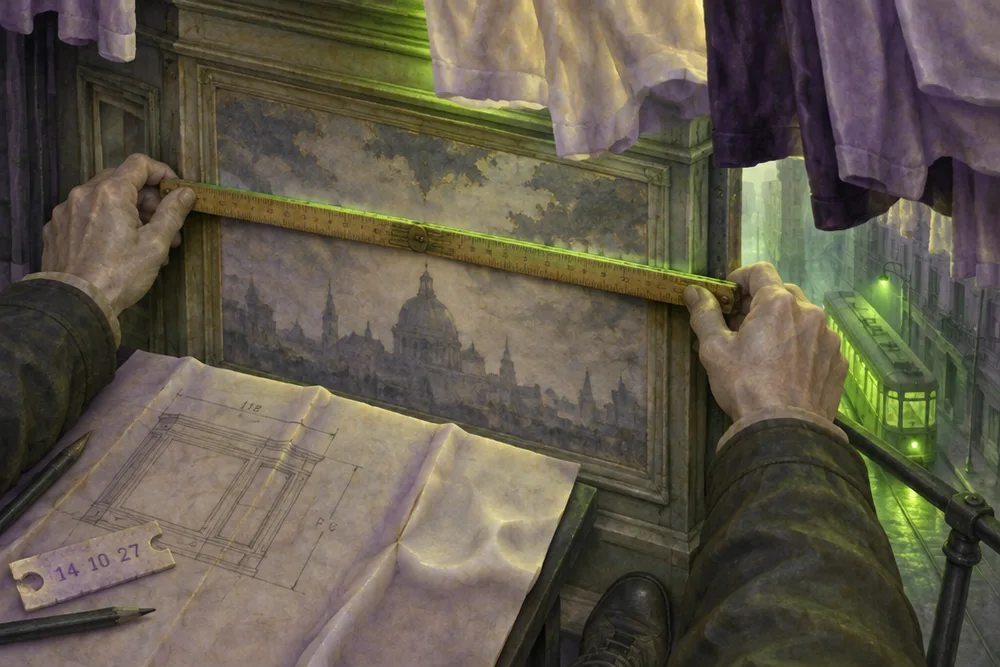
The sound came back solid.
“Paint,” he said.
Mara leaned past him. “All three?”
He tested the second, then the third. The rectangles had been painted directly over brick. From Rusk Street they must have looked like windows from a distance, the kind of harmless architectural make-believe put up to save the face of a building. Up close, the brush strokes stopped at the uneven mortar.
“Could cut through?” Mara asked.
“Not without making a hole in the wall. And even if we did, the sightline would be wrong.” He unfolded the rule and held it across the bay. “The crossing needs a view of the street. It isn’t just a window-shaped gap.”