The Bell Was Not Carried
Page 97 of 257
Chapters
At the next usable tide, Elias’s clerk took the east-bank position. Fanny went to the west side, where the drying yard’s blind turn cut the wash court from the uphill houses. Martha Venn stood beside her bell bracket, striped apron over her thick skirt. The west bell’s split loop hung in its fixed place. Martha gave it a glance, then watched the lane.
“No names?” Martha asked.
“No names.”
“No dates that can be joined to the laundry book?”
“Only the observation day and tide.”
Martha gave a small nod, not approval exactly, but permission to continue. The bell remained quiet. Across the inlet, the official east bracket was visible above the steps, empty of any sound.
Nell came with the second-shift observer as the cannery whistle sounded. The woman was broad-shouldered beneath a plain shawl, and she kept a little distance from Nell. She did not offer her name. Fanny did not ask for it.
“I want to see where the marks go,” the woman said.
Fanny held the page so its blank headings showed. “There. Carried on one side, turned back on the other. No names.”
“And you won’t ask me to stand up at a hearing?”
“Not unless you decide to.”
“And if I decide not to?”
“Then you don’t.”
The woman examined Fanny’s face as if searching for a hidden line of small print. “I think your sister ought to have a boat,” she said. “I don’t think that means the rest of us owe you our histories.”
“It doesn’t.”
Nell kept silent. Fanny saw that she had brought the woman because she trusted the terms enough to let them be tested, not because she expected agreement.
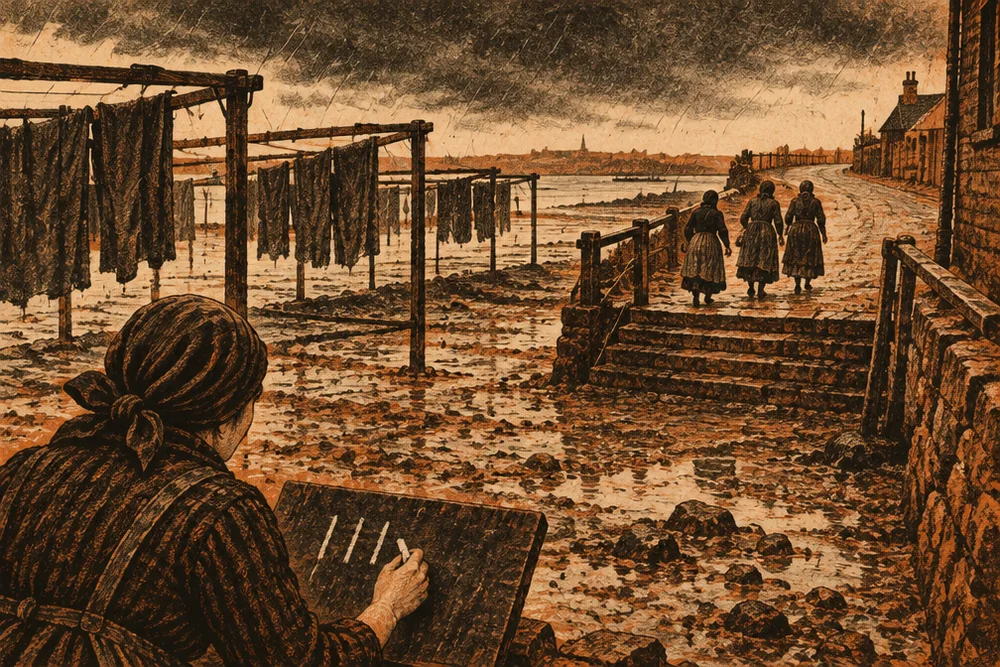
They took positions: Nell and the observer on the west side, Fanny at the east steps with Elias’s clerk. The tide lapped below the mud line. A group of cannery women came down the public lane, moving together, their hems darkened by the damp. They stopped where the steps failed, spoke among themselves, and turned back toward the uphill road. Fanny made three chalk strokes on the board she had brought, one for each woman who had approached the water and gone no farther.
She did not write the women’s names. She did not write that one carried a basket or that another had a red thread at her cuff. The strokes were enough to say that the lane had brought people to a crossing the water did not yet offer.
Later, at the Salt Step office, Elias compared the sheets. He had written times in a hand narrower than Fanny’s, each entry accompanied by a note about tide or weather. “Three turnbacks,” he said. “No carried passengers at that place and hour.”