The Bell Was Not Carried
Page 96 of 257
Chapters
“She’ll tell you if she comes.” Nell’s forward neck made her seem always to be leaning toward the next task. “She works the later shift, and she’s been docked for arriving late when the east steps were mud. She doesn’t want that turned into a story about herself.”
“It won’t be.”
“You can’t know what people will make of a mark.”
Fanny heard the rebuke and let it stand. The dates beside the laundry entries had taught her how quickly an ordinary fact became a household’s address. “Then we won’t mark a person. We’ll mark a stroke for each attempt, at the time it happens. If she decides she wants no stroke, we leave it out.”
“And if she says she turned back because the path was unsafe?” Nell asked.
“We record what we saw. If she tells us a reason, we do not put it beside the mark.”
Nell studied Fanny, testing the terms more than the woman. “You’ve learned to leave a space.”
“I have.”
“Good. Because she won’t do this to help you. She’ll do it to find out whether the count is worth trusting.”
Fanny pushed the tally sheet toward Nell, then stopped before offering it. “Take a copy if she wants to read it. Not the original.”
“She’ll want to see the blank columns.”
“Then she can.”
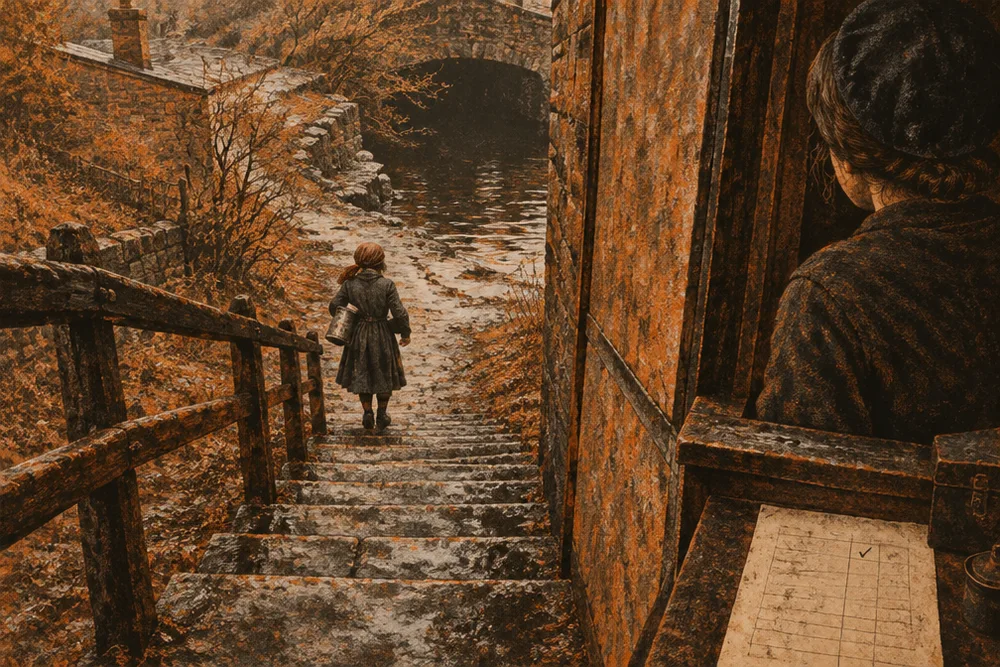
Nell put the tin back under her arm. “I’ll bring her at the whistle.” She went down the stairs without taking the sheet. Fanny watched her pass the hatch and disappear toward the lane, carrying her dry stockings through the wet morning as if that small precaution were a form of evidence too.
The first observation was set for a suitable workday, when the tide gave the west landing enough depth and the cannery whistle sounded before the east steps could be used. Elias stood near the public lane with his clerk; Fanny stayed by Salt Step, where she could see the steps and the path leading uphill. She had brought no names, only a sheet divided by bank, hour, carried, and turned back.
The first woman came down the lane at a brisk pace, then slowed where the mud began. She looked across the creek, looked at the east steps, and turned uphill. Fanny did not know her. The woman did not look toward the office.
A little later a man waited at the west landing while Temperance brought the boat in. He stepped aboard, crossed, and was entered under carried. Fanny wrote one stroke. The figures were too small to feel like an argument, but the distinction mattered: one person had used the service; one had come to the water and left without it.