The Bell Beneath the Minutes
Page 9 of 242
Chapters
“That does not give me permission to release the master.” Nessa stood aside to let Una enter. “It may give us a reason to examine how the extract was made.”
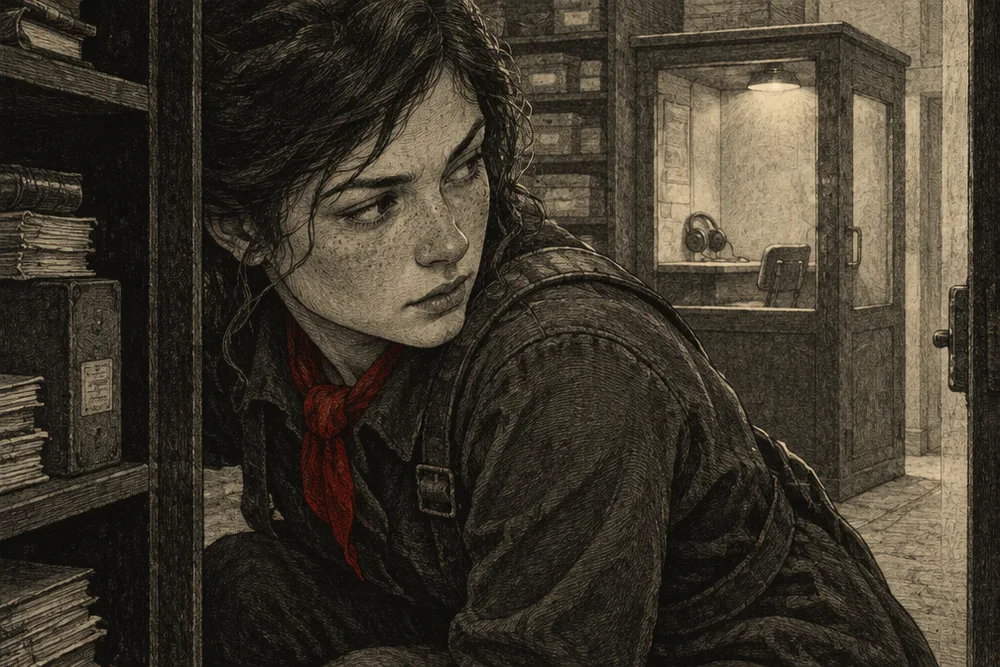
The archive floor was crowded with shelves, cartons, and labeled boxes. Beyond them, through a glass partition, Una could see the listening booth where padded headphones hung over a small table. Nessa did not invite her to sit until she had checked the visitor register.
“I can confirm the collection holds oral-history interviews relating to the flood and the relocation,” she said. “Some are public. Some are restricted by the people who gave them. The council exhibit is not a public archive copy.”
“Who made it?”
“The register will tell me what I’m permitted to say. I won’t guess.” Nessa crouched beside the chair as Una sat. “Did your father tell you he had taken part in an interview?”
“No. He told me he worked on the relocation. He never said where he went, or who he spoke to.”
Nessa’s gaze moved briefly to the square case. “And the sentence?”
Una hesitated. It was strange to hear the promise described as a sentence, a line of material that might be identified and compared. “He said it to me in our kitchen. I was twelve. No one else was there.”
Nessa straightened. “Then you’re not just asking to hear a family recording. You’re asking how a private statement became evidence in a land matter.”
“Exactly.”
“I can check the registers. I can’t promise the master will be available today.”
“Can you at least confirm the bell?”
“Not without hearing the relevant recording. You can tell me what you think you recognized. That is different from me validating it.”
Una felt a spark of frustration, then saw Nessa’s fingers resting on the edge of the register. The archivist’s caution was not a refusal to help. It was a boundary with a reason behind it. The council had taken a piece of sound and made it serve a legal purpose; the archive could not answer by treating other people’s voices as objects.
“It sounded like the Chain Room bell,” Una said. “My brother worked harbor dispatch. He recognized the broken return.”
Nessa wrote something down. “I’ll note that as a family identification, not an archival finding.”
The distinction was small, precise, and irritating. It was also the first thing Una had heard all day that did not pretend to know more than it did.
“When can you check?”
“Tomorrow morning. The person who handles restricted access is in then.”
Una gathered her case. “I’ll be back.”