No Crossing at Five Forty-Three
Page 98 of 273
Chapters
A rescuer came up from the outer wall with a fresh reading. Water had entered some shallow void or channel beneath the foundation, but the line was not enough to establish the cellar floor’s condition. The old measurements gave them only an approximate elevation, and the tide table did not tell them how quickly water might rise inside a closed space.
“We can lower a camera through the vent,” Baird said. “If it reaches the chamber. No one goes down until we can identify the route and assess the water.”
Gideon gave a short nod. It was not agreement with the delay. It was acceptance that urgency did not make an unknown stair safe.
Tamsin looked back at the door in her mind: the lock, the paint line, the dark beyond. The search had moved beneath the terminal, but not yet into it.
The camera reached the vent after two attempts. Its cable scraped against the grille and snagged on something inside; the rescuer eased it back, changed the angle, and fed it through again. Baird watched the small monitor on a portable unit balanced on a crate. The image shivered in shades of gray, catching stone, then darkness, then a scatter of pale flecks that might have been mortar.
“Hold there,” she said.
The rescuer stopped the cable. The picture steadied enough to show a low horizontal surface and the bottom of a wall. Water made a broken shine along one edge. There was no clear view of a doorway, a landing, or a person.
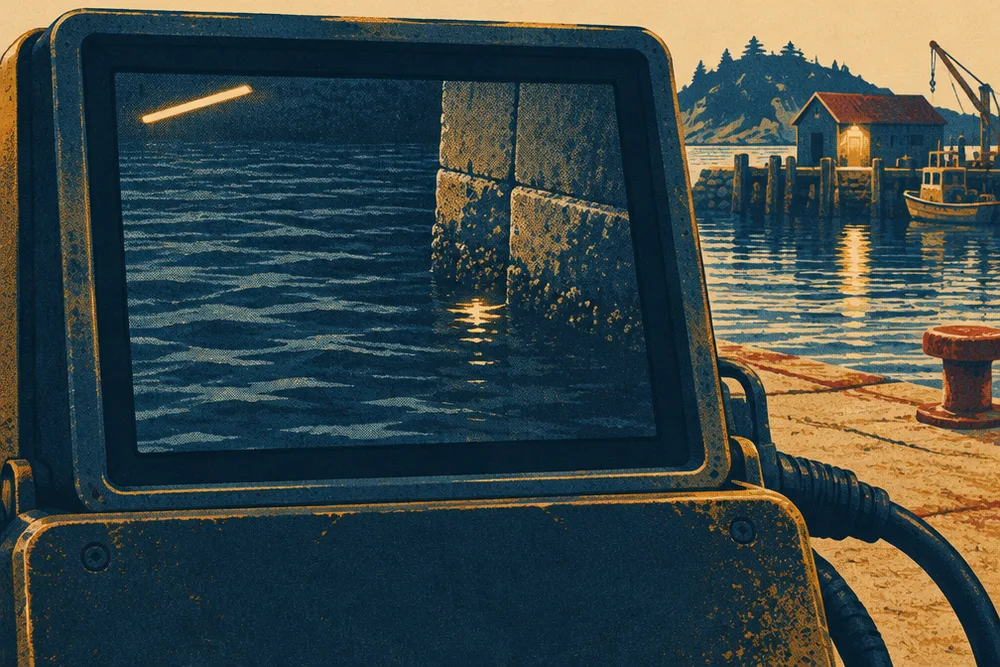
Tamsin leaned closer. “Can it turn?”
“Not with this camera.” Baird studied the screen. “And I can’t tell how deep that water is.”
A rescuer marked the point where the cable entered and measured its length. The distance did not match the old sketch exactly, though the sketch had no scale. The vent might open into the cellar, or into a drainage channel beside it. The camera had established that there was a void, not that Kit was in it.
“We need the stair,” Tamsin said.
“We need to make sure we can bring someone back up it,” Baird replied. “If the entry is the door we found, we’ll need tools, lighting, and a way to check the lower landing before a person commits.”
Gideon stood beside the terminal wall with his gaze fixed on the narrow cream door. He seemed to be measuring the building from memory, setting what he remembered against what was physically there. “The first flight turned left,” he said. “If it’s still the same stair, you won’t see the bottom from the door.”