Sums Behind the Wash, Desks Under the Hammer
Page 8 of 250
Chapters
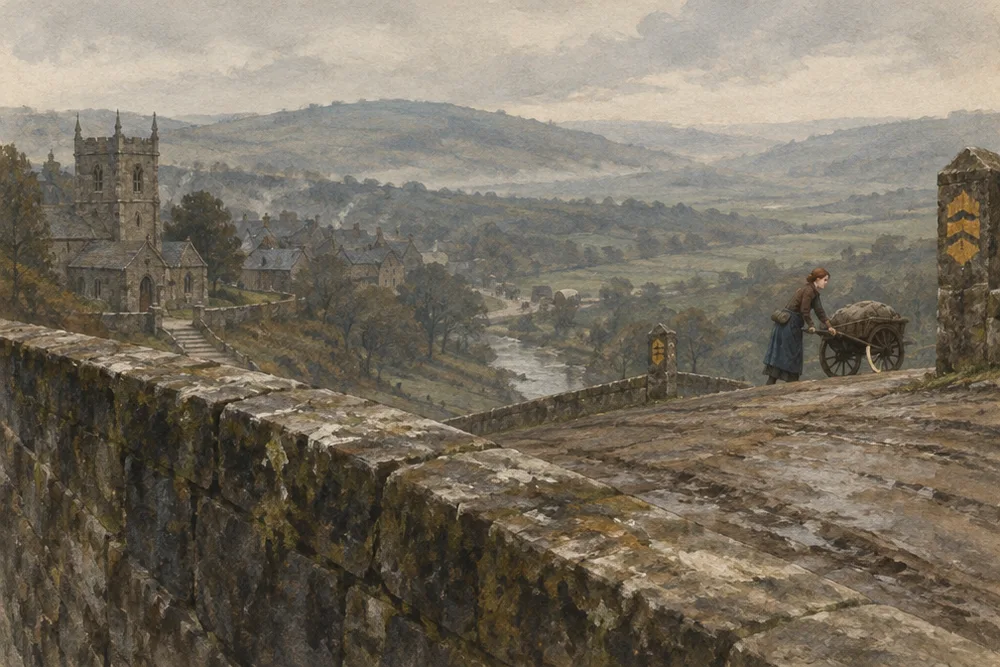
The morning had brightened to a weak gray. On the church steps, she checked the handcart’s wheel and the tie on her tool roll. The pale replacement spoke held, though it flexed when she pushed down on the handle. She would have to keep the load balanced. A bell was heavier than it looked, and the road had already begun to fill with wagons heading toward the clearance ground.
Back at the workshop, she packed a length of sacking and a short piece of rope. The portable lasts were still on the cart. She moved them closer to the axle so they would not tip. The bench’s chalk mark showed through the doorway, a pale square around its edge. She made herself look away.
There was no use carrying the thought with her. The bell had to reach the hill; the money had to reach her hand; the bench had to remain unsold until she could bid. In that order, the day seemed possible.
She wheeled the cart out of Low Wreak as the village woke to the sound of removal. Doors opened, then shut. A boy carried a kettle with both hands. Two men lifted a dresser onto a wagon and argued over whether its back would clear the gate. At the far end of the lane, a woman stood watching the survey stakes instead of packing.
The chalk boundary crossed behind Elsie’s workshop and disappeared under the road. She looked back once. The workshop door was still open, and through it she could see the bench in the dimness. The mark around it looked almost like a frame. She had never thought of it as something that could be separated from her work. Now the county had given it a number, and the auction would give it a price.
At the bridge, she met Mr. Dallow again. He was measuring the stone parapet. “You’re taking the cart out?” he asked.
“I’m taking it to Hob Kiln.”
“Bring it back by dusk.”
“It isn’t yours.”
“The road will be closed tonight. Anything left on the wrong side may be held until arrangements are made.”
“The cart is borrowed.”
“Then you’d better bring it back.” His eyes flicked to the tied tools and the empty space where a load would sit. “You’re collecting something?”
“A bell.”
“That’s on the list.”
“So is the bench.”
“You know what to do if you want it.”
“I know what you’ve told me.”
Dallow gave a short nod, neither apology nor permission, and went back to his measurements. Elsie pushed the cart over the bridge. Its wheel clicked at every turn, and the pale spoke flashed whenever it came around.