Sums Behind the Wash, Desks Under the Hammer
Chapter 14 · The Crescent Under Cloth
Page 163 of 250
Chapters
The road board’s notice had been nailed over the old depot door, but the nail heads were already rusting. Elsie read it twice in the gray morning, though the words did not alter: Rake Shed, partition and fit-out to be completed by the proposed tenants; no materials supplied. Behind her, the lane ran down toward the washhouse, where the school was still borrowing a room between batches of linen. Ahead, the shed stood above the reservoir line, its empty windows looking over the valley that would soon be water.
She put one hand against the door jamb and measured the space again by eye. A partition meant boards, not a curtain; it had to make two rooms that could be used without one trade swallowing the other. The road board wanted a clear exit from each side. The dry floor was narrow by the drain trench, and the sound boards in the village had been inventoried, sold, or carried off. Agnes had said they could not put children beside a damp wall. Nell had said she would not surrender another strip of laundry floor for the sake of a promise.
Mina crouched beside the drain, a slate tucked under her arm. She had drawn a rough plan in chalk on the concrete. “If the wall goes here, the back door opens into the school. If it goes there, it blocks the turn.” She tapped two points with her pencil. “The desks need room. And the little ones need to get past without knocking into the wash baskets.”
“You’ve allowed for the drain,” Elsie said.
“I’ve allowed for the bit that smells.” Mina locked her knees and looked up at the shed roof. “You said we were going to have a proper room. Proper means you don’t tell me to squeeze in wherever there’s space.”
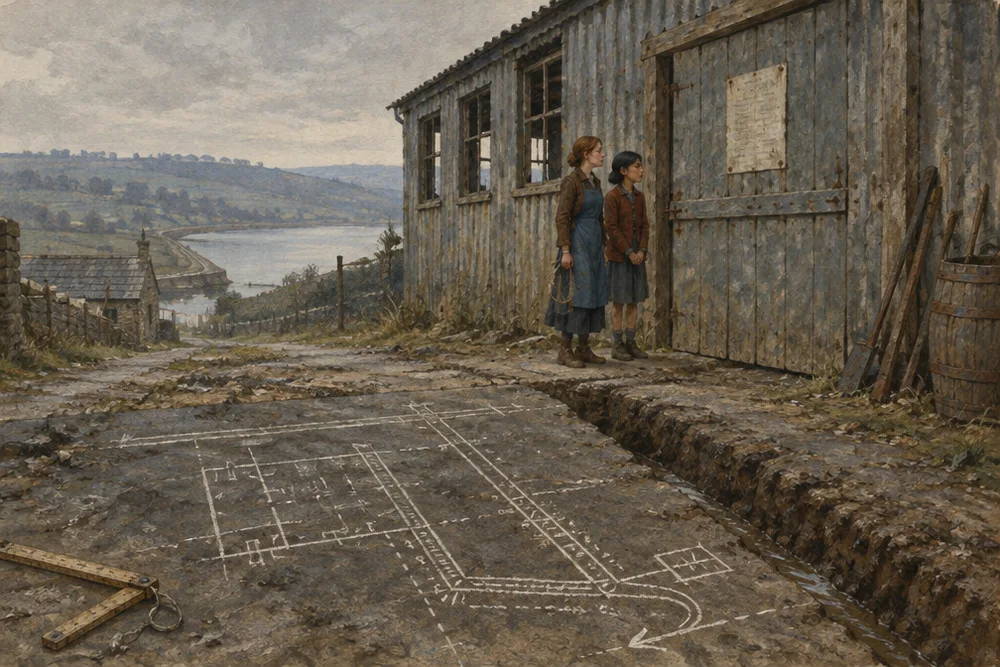
Elsie felt the familiar pull of her left shoulder as she bent to look at the marks. “I didn’t say squeeze. I said we’d find out what the boards cost.”
“And if they cost too much?”
Elsie folded the notice down along its old crease. “Then we find out what else they’ll take.”
The inquiry took her to Hector Bale’s salvage yard, beyond the weighbridge, where timber leaned in stacks beneath a corrugated roof. He had sent word that he might have boards dry enough for a partition. Elsie went with a tape measure, her waxed thread still looped at her wrist, and the list of lengths Mina had chalked out. She had not told the girl how much she feared the answer.