Sums Behind the Wash, Desks Under the Hammer
Page 26 of 250
Chapters
Nell’s mouth tightened slightly. “That will be Ivo.”
“You know him?”
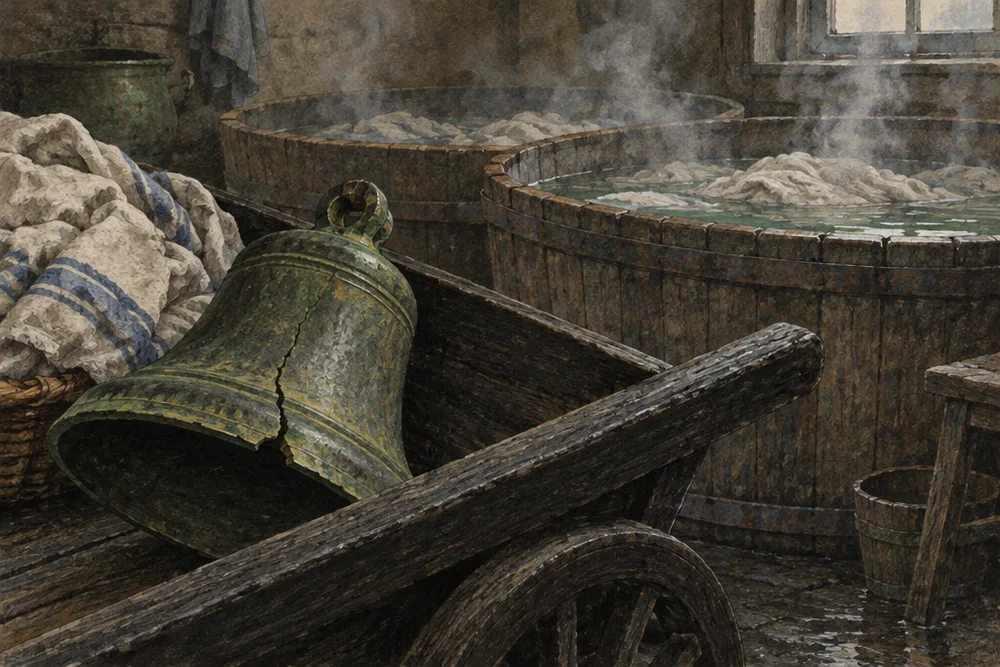
“I know what he does when he’s helping. He finds the parish boundary and stands right on it.” She picked up the brass tally and turned it between her fingers. “Did he tell you why we need a bell?”
“No.”
“Friday. County inspection. The families have started a school because the county won’t provide one here. I need a bell to tell them when the room is available and when it isn’t. The children need to know a lesson has begun without my shouting over the wash.”
The answer made the errand look different. Elsie had been paid to bring a cracked object uphill, and the person waiting had not been expecting a relic. She had been expecting a tool.
“The inspector can recommend provision,” Nell continued. “She can’t appoint a teacher or promise a building. Agnes is willing to teach pending a real appointment, not forever on gratitude. We’re making the best of this room until we can do better.”
A sharp splash came from the tubs. Nell turned at once. “There’s the paid work.” She crossed to the nearest copper, leaving Elsie with the bell and the sounds behind the lath.
“You can put the cart there,” Nell called. “Keep the wheel clear of the gate. And don’t strike the bell yet.”
Elsie parked the cart against the sorting-room wall, where it would not obstruct the gate. Warm damp gathered on her face. The room smelled of clean linen, lye, and the sour trace of clothes that had come in from work. Beyond the lath, the pupils recited their sums, lost their place, and began again.
“Fourteen and nine?” the teacher asked.
“Twenty-three.”
“And fourteen and ten?”
“Twenty-four.”
Elsie lifted the edge of the lath curtain and looked in. The room was long and narrow, its limewash streaked where wet cloth had brushed it. Children sat on the floor with slates balanced on their knees. A woman in a moss coat stood upright among them, chalk dust in the deep pockets. Her iron-gray hair was braided around her head. Her eyelids looked heavy, but her voice did not.
“If you’re coming in, come in,” she said without turning.
Elsie let the curtain fall. She was not a pupil and did not want to announce herself by staring. The children’s posture made her own knees remember long hours bent over a shoe. A slate was not a desk, but it did not steady itself. One child wrote with a hand braced against the floor; another had a slate on top of a folded apron.