Sums Behind the Wash, Desks Under the Hammer
Page 244 of 250
Chapters
She took a sheet of brown paper and wrote out a notice in pencil. Cobbler, Elsie Ternlow. Repairs collected and returned on the lane. She paused over the word cobbler. Customers had asked, for years, whether she could do a man’s repair. She had answered by doing it, and sometimes by letting her father’s name carry the weight of the answer. Here she had no father’s bench and no father’s name on the door. She copied the notice again, this time in ink, and pinned it inside the front window.
A knock came while she was smoothing the paper. The first customer was a woman from one of the uphill cottages, holding a shoe by its heel. The leather was split where the upper met the sole, and the edge had been repaired once already. The woman looked at the worktop, then at Elsie.
“You’ve settled in, then?”
“I’ve opened the door.”
“Can you mend this?”
“I can look at it.” Elsie did not say yes before she knew the damage. She took the shoe carefully, turned it in her hands, and pressed the seam with her thumb. The thread had pulled through softened leather. It would need a new hold, not merely a tighter stitch. She looked at the woman and named the price and the day she could return it.
The woman did not haggle. She set down the deposit. Elsie entered the amount in her book, set the shoe on the elm, and turned it so the split faced the light.
The woman stayed while Elsie examined the shoe. Her name was Mrs. Bell, and she lived in one of the dry-end cottages that had gone first to families with reservoir wages. She explained that the shoe was for her husband, whose work took him along the muddy lane. The old repair had lasted through summer and failed in the cold. Elsie listened, not because the story changed the price, but because the way the shoe was worn changed how she must mend it.
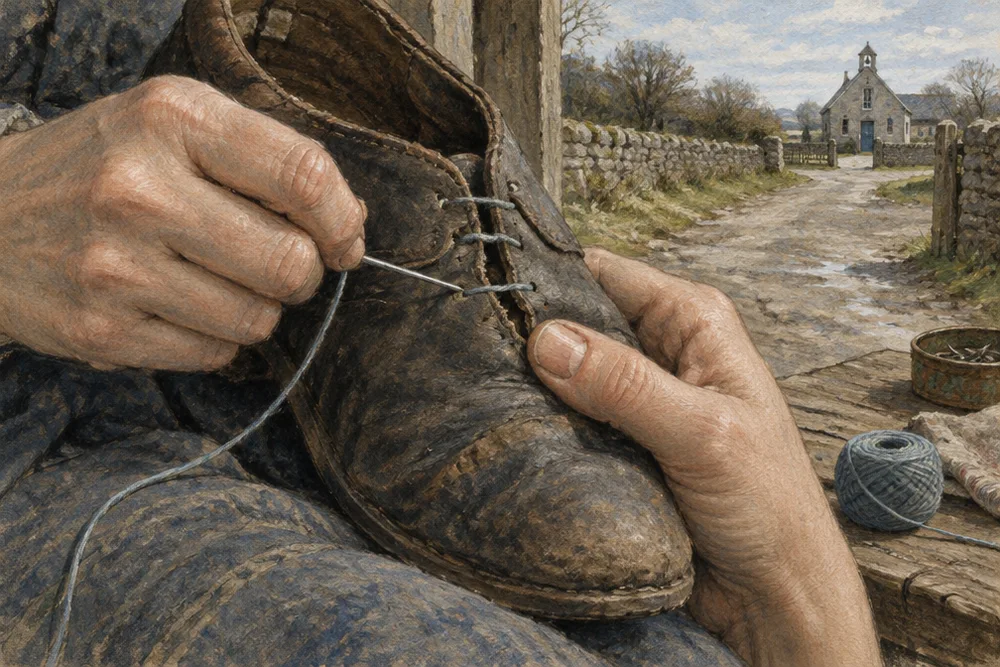
“He walks on the outside edge,” Elsie said. “If I only pull the seam together, it will open again there.”
“He does. Always has.”
“Then I’ll put a small reinforcement under the edge. It will take longer.”
“And cost more?”
“No. I’ve quoted you the work I mean to do.”
Mrs. Bell looked once more at the board. “You’re sure it will hold?”
Elsie could have answered as her father used to: with a brisk assurance intended to close the question. Instead, she touched the weakened leather again. “I’m sure the repair is sound for what the shoe has left in it. I can’t give you new leather for old.”