Sums Behind the Wash, Desks Under the Hammer
Page 182 of 250
Chapters
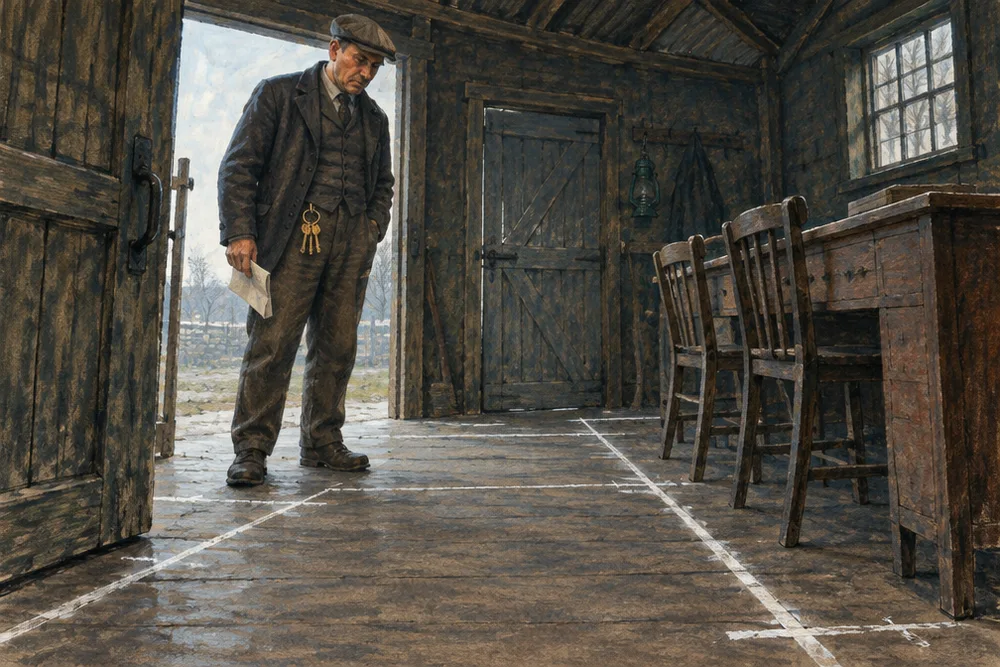
Mr. Dole, the road board’s caretaker, arrived in a flat cap with a ring of keys clipped to his belt. Grint had let them see what floor there was; Dole had come to see whether it could be divided as they proposed. He carried a folded sheet from the board. His eyes went first to the floor marks, then to the desks, then to the back door. The volunteers stood aside to let him enter.
“You’ve fitted the southeast bay,” he said.
“We’ve placed the desks to test the space,” Elsie replied. “The partition is not built. The north bay is still clear.”
“And the broken desk?”
“Made into one sound single. It can be moved.” She showed him the brace beneath the top. “We checked the leg and tested the joint. It doesn’t wobble.”
Mr. Dole pressed down on the desk edge. It held. He lifted the front just enough to see that it could be shifted, then set it back without comment. The repaired desk had already been used as evidence by people who would not be the ones paying for its next failure.
“You’ll have to take care where you place it,” he said. “I won’t have the floor ruined with furniture dragged about.”
“We can put felt under the feet,” Elsie said. “Or use cloth.”
“Cloth collects damp.”
“Then we’ll find a better way.”
He did not accept the answer as a solution, but he did not dismiss it either. He moved through the room, measuring the door swing, the width of the marked partition, and the way the desks left a clear path. At the back door he checked the latch and the step outside. He stood with both feet planted before he made a note on the board’s sheet.
“The exit must remain clear,” he said. “No stores in that lane. No schoolchildren in the other bay. The timber has its own use, and I’ll not have a child climbing over it.”
“We agree,” Agnes said.
“Agreement isn’t a partition.” He tapped the chalk line with his boot. “And this line isn’t one either.”
Elsie watched him inspect the boundary between the bays. She had learned from the clearance inventory that a fixed fitting became part of a building, while a portable tool remained hers. The shed’s future would depend on those distinctions as much as on nails and boards. Their desks were portable, but the partition would be a change to the building. A chalk mark could suggest a division; it could not make one legal or safe.
“We’ll wait for the board’s terms,” she said. “But we need to know what they require.”
“You’ll know when I send them. For now, I’m checking whether the space can be divided.”