Sums Behind the Wash, Desks Under the Hammer
Page 100 of 250
Chapters
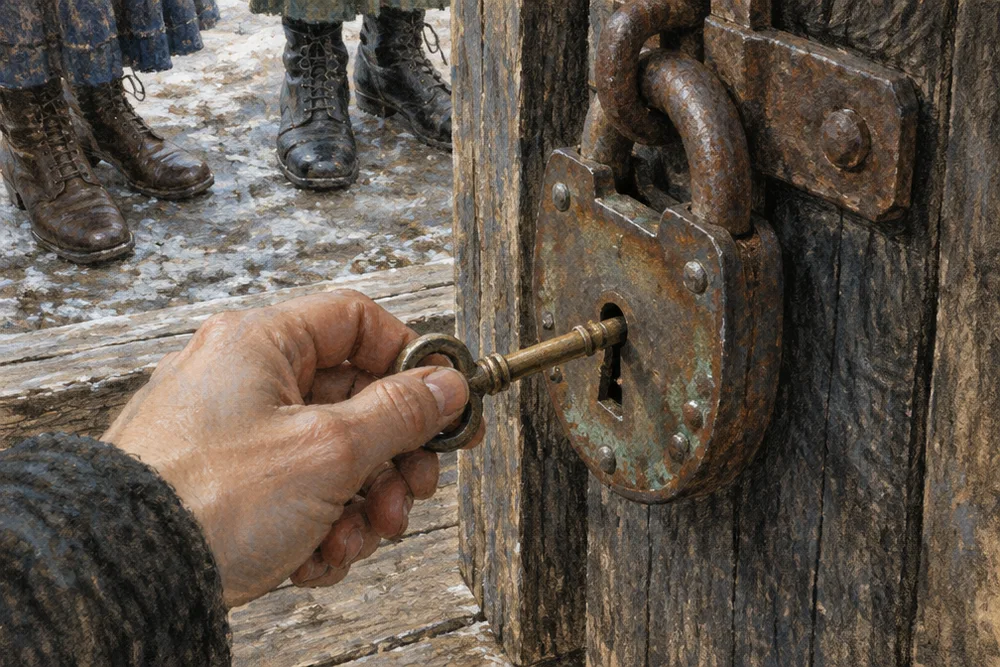
“The parish has a key,” Ivo said. “Or had one.” He took a ring from the drawer and tested three long keys against a small padlock he kept for the coal cupboard. The fourth was a brass one with a flattened bow and a strip of faded red thread. “This opened the depot before the road board took it over.”
“Will it open the door now?”
“That is what keys are for.” He said it with a clerk’s dry patience, then put on his barley-colored muffler and came with her. He had not offered to come along; Elsie had asked whether the key could be tried while she was there. He had chosen to carry it himself.
Mina waited outside the office. When Ivo saw her, he stopped to ask whether her brother was still keeping her from morning lessons. Mina’s knees locked. “Some days,” she said. “Not all the days you put down.”
At the shed, Ivo tried the parish key in the front lock. It entered halfway and stuck. He turned it carefully, then withdrew it with a little scrape. “The board changed the lock.”
“When?” Elsie asked.
“When the road maintenance depot ceased to be parish property. I don’t know the exact date.” He glanced at the bare place on the wall where a notice had hung. “The parish kept the key for its records.”
“A key that opens nothing is a record of a door,” Mina said.
Ivo’s lower lip shifted. “That is not quite how I would put it.”
He tried the rear entrance. The key did not enter the lock at all. For a moment he stood with it in his hand, the faded red thread caught under his thumb. Elsie watched him recognize the difference between being able to point out where his jurisdiction ended and being able to do something about it.
“The road board holds the building now,” he said. “I can write to them.”
“We need to see the floor before anyone writes terms,” Elsie said. “The children can’t be promised a room that turns out to be a puddle.”
Ivo looked at her, then at Mina. “I shall find the proper person.” He pocketed the useless key. “That is not the same as promising he will say yes.”
Elsie’s next round took her past the replacement cottages and down the lane where tenants had set shoes out for repair. She carried a small case of tools, a packet of receipts and a ruled sheet on which Agnes had asked her to record who could attend lessons, and when. It was not the first time she had walked a village collecting worn things. It was the first time the work was meant to discover whether a school could be fitted around it.