One Minute in a Kitchen Chair
Chapter 10 · Last Crossing Home
Page 91 of 235
Chapters
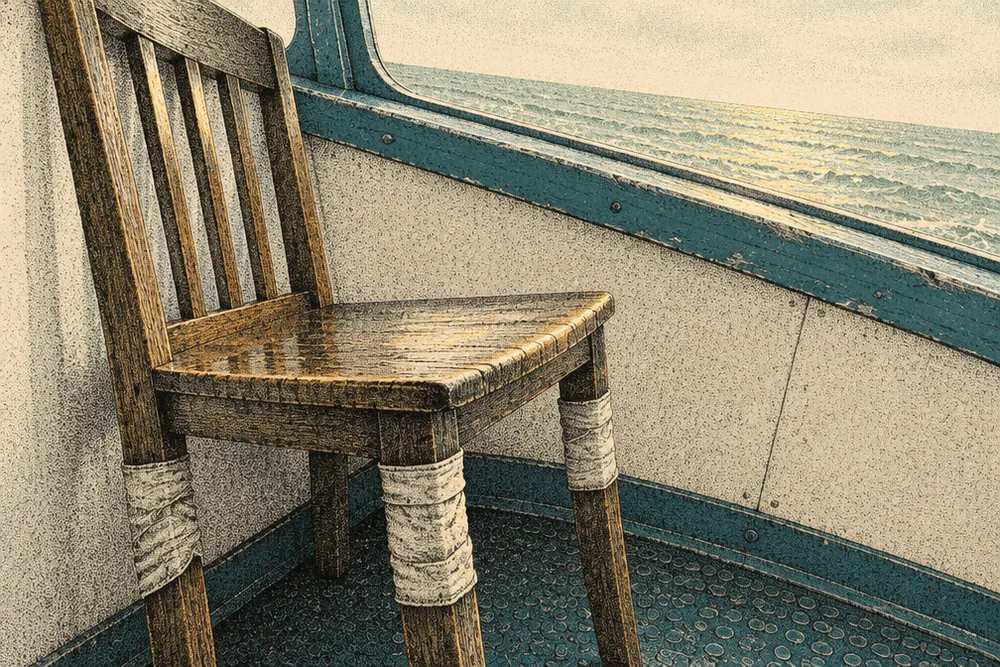
The crossing list lay beneath Mara’s left hand, and the corrected tally beneath her right. She had made three copies in the school annex after supper, pressing hard enough to leave the numbers on the sheet below. The first copy was for the council clerk. The second was hers. The third she had promised to show Mr. Veltrane, the grocer, before anyone used a figure that might point back to his shop.
She set the kitchen chair in the cabin aisle, its legs braced against the rubber mat. The ferry rolled under her in long, blunt motions. Spray stippled the window; beyond it, the island’s dark slope fell away from the harbor. The chair’s varnish had worn pale where people’s hands gripped its back. A strip of blue tape still marked the spot where she had lashed it to the rail the day she began collecting testimony.
There was no one sitting in it now. The chair had gone empty as soon as they finished recording Tamsin Pell’s account and the final conversation with the dock clerk. Mara had left the recorder in her bag, its red light off. The one-minute limit was still a problem, but not the only one. A clean tally could correct the council’s claim that the ferry made empty winter crossings. It could also expose the people who had paid for freight on those sailings.
Mara flattened the papers against her thighs. The table she had built showed dates, sailing numbers, and totals: passenger scans in one column, paid freight loads in another. No cargo descriptions, no invoice amounts, no customer names. She had put a black bar through the last column of Tamsin’s carbon copies before copying the figures. The grocer’s contribution to the count was hidden in a line of aggregate totals.
She had not promised the table would save the ferry. She had promised she would not turn a person’s practical need into a weapon without asking first. The difference seemed plain when she said it to herself. It felt less plain when the figures sat in her lap, firm as a wrench and just as easy to use badly.
At the mainland slip, the footbridge ran inland toward the bus stop and, farther off, Ada Rusk’s fabrication shop. Mara folded the papers into her jacket and unhooked the chair. The ferry deckhand steadied the door while she maneuvered it past a coil of rope. “Taking it home?” he asked. “For now,” Mara said, and carried it down.