One Minute in a Kitchen Chair
Page 46 of 235
Chapters
“Being good at it makes the problem worth solving.” Ada glanced at the two test pieces. “It doesn’t make the problem disappear.”
Mara nodded. She could hear a vehicle on the road outside, tires brushing over gravel. The sound went away toward the harbor. She imagined a person arriving at the shop from the mainland with the whole day in front of them, not watching minutes in case the ferry made the next departure. She imagined herself with a bed somewhere beyond the slip and the cost of it drawn out week by week. She knew what her wages would be; she had counted them until the numbers became stubborn.
“I can practice at the annex,” she said. “We have a bench.”
“You can.” Ada stood and carried the coupons to a rack, keeping the bent edges visible. “Bring another piece when you’re ready. I’ll tell you what I see.” She made no speech about perseverance. Mara was grateful for that. A speech would have given her something to push against instead of something to understand.
Ada walked her through cleaning the work area and checking the machine. Mara coiled the lead without kinking it, brushed metal grit into the bin, and returned the gloves to their hook. The gestures were familiar from the annex. Here, the machine was a little larger and the table scarred by years of work. A length of steel rested near the vise, its end marked in chalk with a job number. It looked less like a lesson than an invitation to keep going.
At the gate, Ada said, “The ferry’s running?”
“It was when I came up.” Mara tried a half smile. “I’ll check before I go down.”
“Do that. The approach gets nasty when the tide and wind line up.” Ada’s elbows tucked close as she folded her arms. “And Mara—don’t mistake what I’m saying. You have a good eye when you let yourself use it.”
“I’ll try to remember that.”
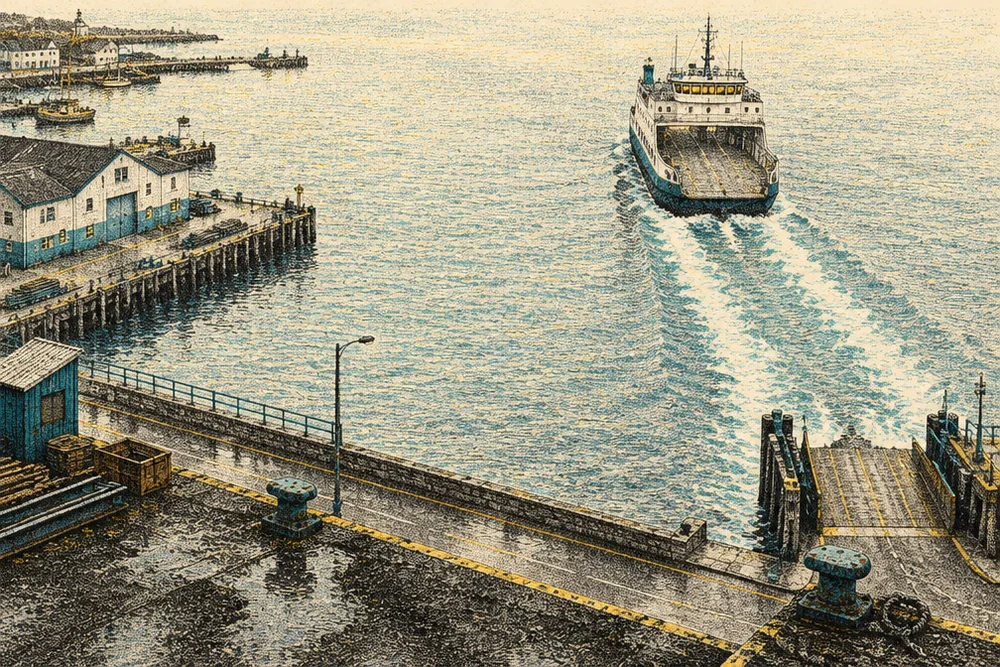
Outside, the wind struck the damp hair at Mara’s jaw. She buttoned her jacket and walked to the edge of the yard, where the harbor opened below the road. The ferry was coming in, its pale cabin above the open freight deck. Small figures shifted behind the windows. On the water, its wake broke into two teal lines that dissolved against the slip.
Mara had spent weeks treating the ferry as a narrow bridge between herself and the shop. She had drawn the crossing as a forty-minute box on a page, then arranged her future around it. Now the box had a second edge: it could carry her to a place that still had no room for her at the hours she needed. The ferry might be essential and insufficient at once.