One Minute in a Kitchen Chair
Page 31 of 235
Chapters
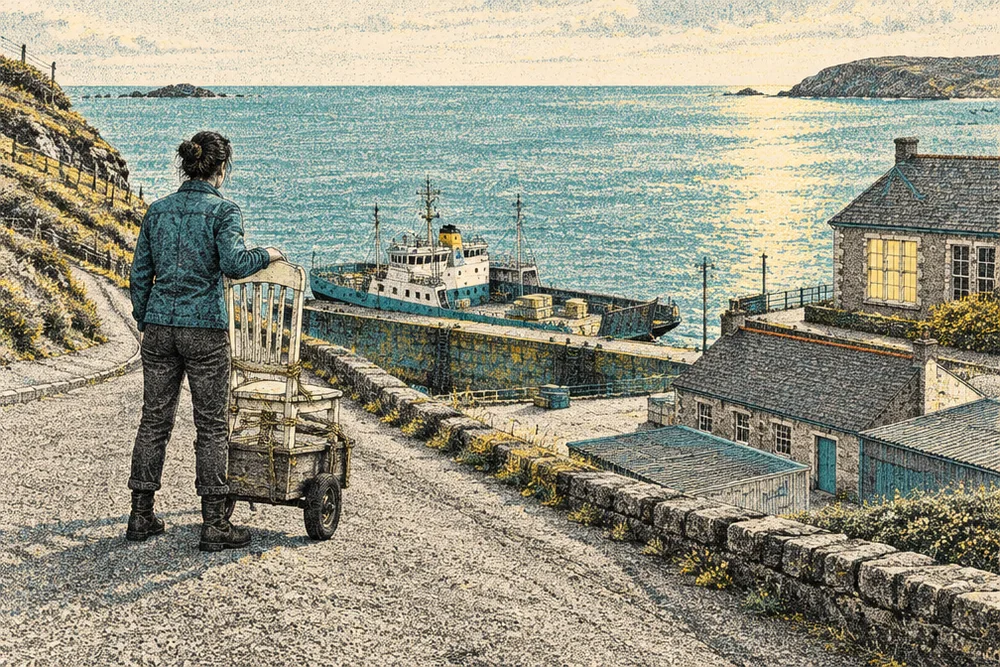
At the top of the harbor road, Mara stopped to shift the chair’s weight. The handcart handles pressed into her palms, and the rope left a red line across one knuckle. Below, the ferry’s freight deck was partly hidden by the quay wall, but she could hear the forklift’s reverse alarm beeping in short, regular bursts.
She turned to look down. The shop’s delivery was already inside, the door closed against the salt wind. In a few days, the crates would be empty and their contents gone. The invoices would remain in the dock office, filed in a drawer separate from the passenger totals. Both records could be accurate. Together they might tell a different story from either alone.
Mara knew how a hearing worked: a question, a speaker, a minute that had to hold its shape when played in a room full of people waiting to decide. She could imagine the cleanest line from Oren’s clip to the council’s motion. Year-round freight rates. Scheduled sailings. Essential goods. But the clip stopped before the complications began, and the council might hear certainty where Oren had offered caution.
She would not make that cut without asking. She would not make any cut without asking. The rule would cost her the easiest version of the argument, and perhaps the strongest. It was still the rule.
At the next bend, the school annex roof appeared above the harbor buildings. A bright rectangle of classroom window caught the morning light. Mara rested one hand on the chair’s back and thought of Ivo’s brother, who needed captioned instruction and a quiet room. The ferry carried what the island could not provide on its own. It also carried people back to a place that could not give every child what he needed.
She began walking again. The chair’s legs knocked softly against the cart as she climbed, a hollow, irregular sound that seemed to count something but would not say what.
At the house, she would bring the recording to Ivo. She would tell him about the refrigerated crates, the loading lane, and the separate receipts. She would tell him that the freight rate assumed the ferry kept running through winter. She would not tell him what to think.
For the first time that day, the ferry’s value did not look like a head count. It looked like a set of dependencies, some visible in a scanner’s green mark, some tucked into paper, and some still waiting for a person to say what they needed.