One Minute in a Kitchen Chair
Page 230 of 235
Chapters
Neri got to the part about the bus driver’s opinion before he paused. His hands moved as he described the argument, long fingers making the shape of the moon’s path against the evening sky. Ivo watched Mara watch him. She didn’t look at Ivo for help, and Neri didn’t look at either of them to check whether his story was being understood. For a moment the road, the slip, the late light over the water all seemed to belong to his telling.
When the story was done, Mara asked, “Did the boy agree with you?”
“No. He said he’ll ask the science teacher.”
“That’s sensible.”
“He said it like he won.” Neri stood and adjusted his backpack. “I’m going to tell Mum.”
He headed up the road. Ivo waited until he was several paces ahead, then followed. Mara fell into step beside him. Her work trousers were stained at the knee, and she carried a lunch tin by its handle.
“You don’t have to come to the house,” Ivo said. “If you’ve got somewhere to be.”
“I was going to return your chair again. Thanks for lending it to Ada for the open day.”
He glanced at the chair in her other hand. It was the kitchen chair he had seen lashed to a cabin rail the previous October, when she began collecting testimony. Its varnish had worn off in a pale crescent along the seat. One of the back slats bore a small black mark where the recorder had rested. It had sat in the former ticket hall during the hearing too, though no one had needed it there. By then the chair had become a thing people recognized, and Mara had stopped letting that fact decide what it was for.
“It can stay at ours,” he said. “We have enough chairs.”
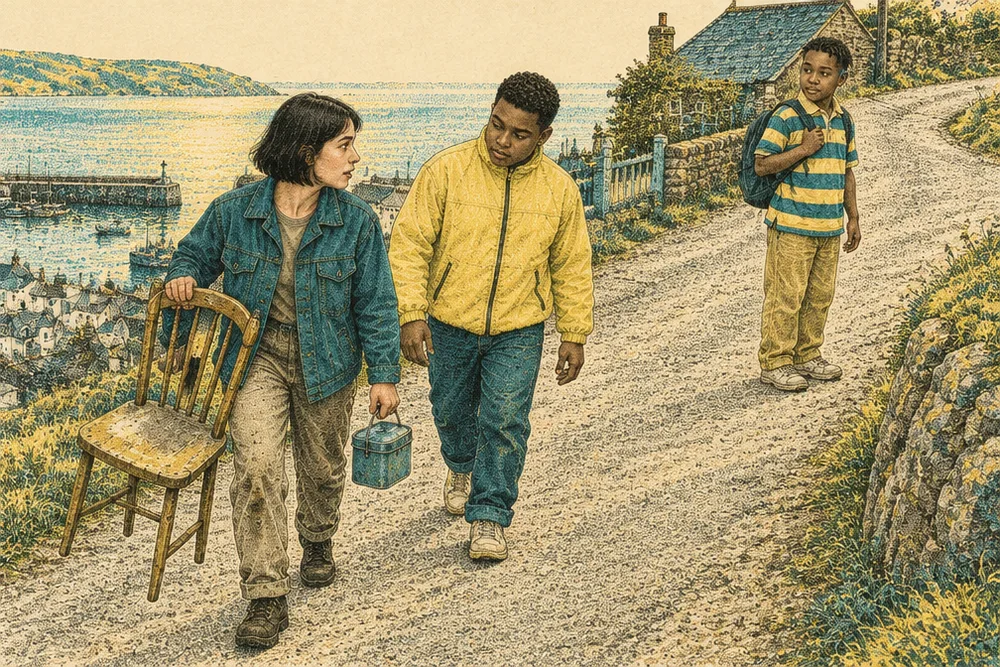
“Your mum asked for it back.”
“Then she can have it back.”
Mara held it by the top rail. “I keep thinking about how much got packed into that minute. Numbers, Neri’s voice, the people who didn’t want to be used as examples.”
“You didn’t use them.”
“I could have.”
He understood the distinction. She had made two cuts, one that argued for the route and one that ended with Neri’s uninterrupted request. She submitted the second, and kept her own commute audible in it. The minute did not settle the decision; it made it harder for the council to pretend the decision was only about a passenger count.
“You let people decide what they gave you,” he said.
“Not perfectly.”
“No.” Ivo looked at the chair. “But you kept asking.”
They walked on. Ahead, Neri had stopped at the bend, waiting with a patient tilt to his head.