One Minute in a Kitchen Chair
Page 123 of 235
Chapters
“The report I sent council is a passenger export,” he said. “That’s what the request asked for. Zero passenger scans means zero passengers.” He spoke without defensiveness, but he kept his hand on the top binder. “Freight’s handled through a different system.”
“We know,” Mara said. “That’s why we asked for the totals, not the names. The report calls these crossings empty. We think the word is being read as empty of everything.”
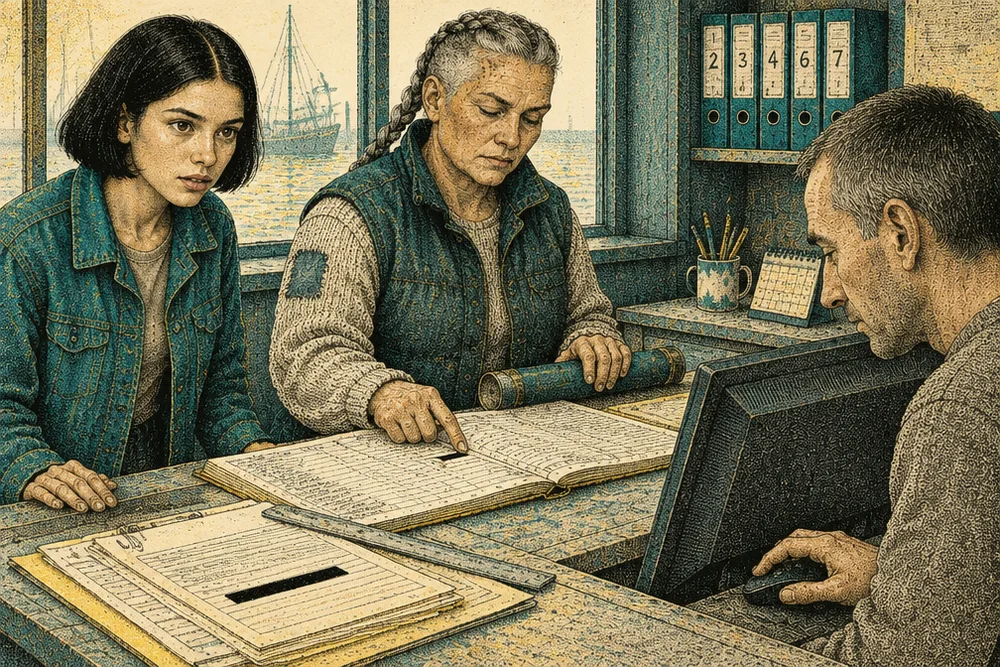
Tamsin set down her tube. “I worked deck for twenty-six years. I saw cargo come aboard on half the sailings they’re calling empty. But I didn’t keep the books. These did.” She unrolled copies onto the counter, placing a ruler across their curling corners.
The clerk did not touch them. “Those are freight office receipts.”
“Copies,” Mara said. “The grocer cleared aggregate figures. We can compare sailing dates and receipt totals. If the records don’t match, you can tell us why.”
The clerk looked at the paper Mara offered. It had three columns: date and sailing, paid freight transactions, passenger scans. The grocer’s prices were gone; his name was gone, too. Mara had replaced the handwritten supplier details with a black bar, then copied the totals in her own hand.
“You’ve left out the crossing number,” the clerk said.
“There isn’t one on the public passenger sheet,” Mara replied. “Only the time. We matched by date and scheduled departure. Tamsin checked the deck log.”
He finally lifted the top receipt between thumb and forefinger. “A receipt proves someone paid. It doesn’t prove the boat sailed.”
“That’s why we’re here,” Mara said. “Not to tell you the answer. To ask whether the two systems can be matched officially.”
The clerk’s mouth tightened at the word officially. He set the receipt down, aligning it carefully with the counter’s edge. “Let’s see what you’ve got.”
Mara spread the copies into date order. She had used paper clips, not staples, so the clerk could lift each page without tearing the thin carbon. The receipts were faded at their edges, the ink darker where a crate had pressed a damp mark across a line. Tamsin placed a penciled deck log beside them.
“This is the second Thursday in September,” Tamsin said, tapping a square with one blunt fingernail. “Seven-ten departure. Two pallet spaces, one refrigerated crate. I remember the crate because the tie-down was frayed. We changed it before we cleared the berth.”
The clerk turned to his screen. His chair squeaked as he leaned in. He searched by date, then by departure time. “Passenger scans: zero.”