Night Train for a Vanishing Town
Page 74 of 188
Chapters
“There’s a carriage mirror in the luggage rack,” said the man with the walking stick. “The convex one. If I hold it out, maybe we can see around that bend.”
Inez looked back at him. “Can you do that from inside?”
“If someone braces the window. I don’t need to lean out.”
They found the little round mirror, its metal rim dulled with age. A passenger threaded a cord through its handle and held it just beyond the glass, secured by two other hands around the frame. The view in it wavered in the rain. At first it showed only warped sky and a smear of hillside. Then the arch appeared, distorted but recognizable, its stone crown intact. The rails ran across it. Below and to the side, a narrow wooden structure hung at an angle, one end torn free.
“That’s the walkway,” the man said. “It’s separate.”
The other observer checked through a second window, then nodded. “I see it. The rail line’s there, but we still can’t tell the far edge.”
Mara listened to their description. “That matches the old arrangement. Walkway attached on the upstream side, rail on the crown. The inspection path was cut above it so crews could check the stonework. Don’t mistake a broken walkway for a broken arch.”
“Can we confirm the line from the high path?” Inez asked.
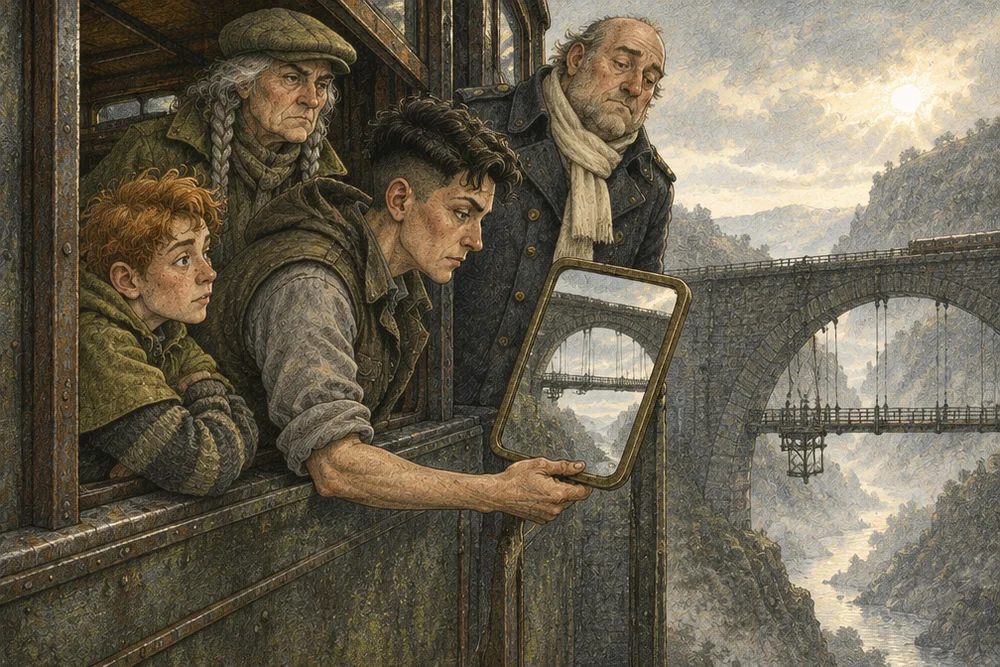
“If the path is firm enough to use,” Mara replied. “I won’t call it safe because I remember it. I’m not there to feel the ground.”
That distinction mattered. Mara had the route knowledge; the people at the trackside had the view; the passengers had the patience to compare the two. No single piece was enough. Inez watched the lanterns below the alders. The figures stayed put, waiting for a decision that would not ask them to prove their nerve.
“Could the train move a car length?” Toll asked. “Just to improve the angle.”
“Not until we know the rail holds.”
“And if we keep waiting?”
“Then we keep waiting.”
Rain raced down the cab glass in crooked lines. On the report board, the row for the arch remained empty, while the train’s headlamps laid two narrow islands of cream-colored light across the wet rails.
They used the mirror for another view, shifting it a hand’s breadth at a time. The first passengers remained braced at the window, their knuckles white around the frame. A woman from the second coach called out landmarks as she found them: the cracked capstone on the left, the dark joint beneath the rail, a pale line where runoff crossed the stone. Someone wrote each detail on the board.