Night Train for a Vanishing Town
Chapter 11 · Report What We See
Page 122 of 188
Chapters
The western saddle was under water, and the train waited on the east side of it with every lamp burning.
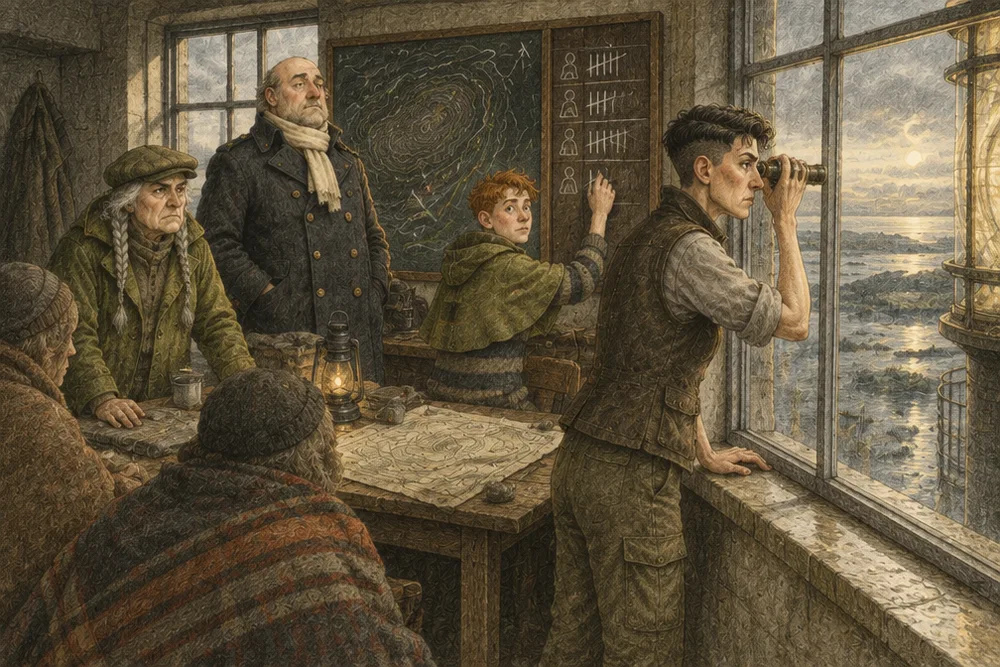
Nessa stood at the lamp-house window, one palm flat against the glass, and watched the dark below Slate Crown. The rail line vanished where the saddle dipped between the arch and the west-bank rise. Rain stippled the flood in silver threads. Now and then a submerged signal post showed its head, then disappeared again beneath a ripple. Beyond it, the far embankment was only a darker seam in the night.
Behind her, the lamp house had become a count room, a waiting room, and a place to argue quietly. Wet coats steamed near the stove. The seven shift workers rescued from the cut sat together on benches, one of them with his arm bound close to his ribs. Kit Rusk was at the board, pencil poised, checking names against the paper roll he and Nessa had reconciled twice. His father sat wrapped in a blanket beside him, pale but awake.
Every person listed for evacuation had been brought to the shelf. Every person on the shelf had a mark beside a name. Nessa had no use for the comfort of saying it was done while the train remained trapped on the wrong side of a rising river.
The battery radio crackled on the table. Toll Fenner leaned over it, ivory scarf dark with rain at the ends. He had the paper movement log open beneath his elbow, and a stub of pencil in his hand. Each time the radio spoke, he wrote down the exact minute before asking anyone what it meant.
“Dispatch says no authority to cross until the saddle is reported passable,” he said. “They’re waiting on a level reading from the west-bank gauge.”
“There isn’t a gauge on the railbed,” Nessa said. “Only the pump-house marks.”
Mara Sedge, near the door, looked up from the strip of track diagram she had spread across a crate. Her silver braid was wet at the nape. “A mark tells us where the water was when somebody looked. Not what the ballast is doing now.”
“I know,” Nessa said. She took the notebook from the shelf under the window. “I’m going to the pump house.”
The pump house crouched below the lamp house, its stone walls slick with rain. Nessa took the steps two at a time and shouldered through the warped door. Inside, the air smelled of wet iron and oil. A gauge pipe ran down the wall, its brass face clouded with condensation. Beneath it, someone had scratched a set of dates and water heights into the plaster: the town’s informal record, kept by whoever had been on duty when the official instruments failed.