Night Train for a Vanishing Town
Page 188 of 188
Chapters
“You will,” Mara said. “And when you know, you’ll say what you know. No more, no less.”
The train entered a shallow cut. The light thinned against the window, and the green slopes rose on either side. For a few seconds the carriage held only the rattle of wheels and the rustle of coats. Then the line emerged onto open ground, and the morning returned.
Inez thought of the lamp house at Hushbank, of the way its lit windows had once looked like a promise from the far bank. She thought of Nessa at the gate, refusing to let a railway timetable overrule the town’s judgment; of Kit stopping the relay when the saddle began to spread with water; of Toll writing the delay exactly as it happened; of Mara holding the line between her own name and Inez’s. None of them had carried the rescue alone. None had been a substitute for the others.
The new stop would not bring the old streets back. The station below the terraces would remain where the flood had left it, and the people who had lived there would have to build lives elsewhere. Yet the train now had a place to stop near them, and the town had a list that did not forget those its maps had excluded. It had a timetable, a sign, a signal, and people who knew how to halt movement when the facts did not support going on.
The driver sounded the horn for a crossing. The note was low and brief. Inez did not feel the old urge to imagine herself at the controls. She could admire the care of the approach without needing to claim it as hers. In her pocket, the ticket creased softly as the train swayed.
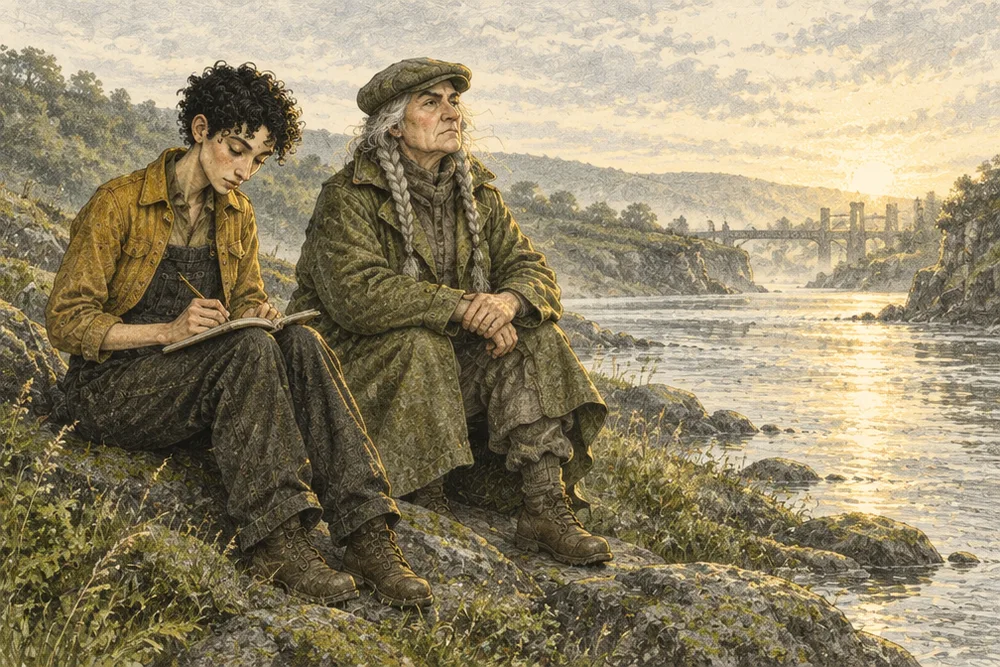
Mara closed her eyes, perhaps resting, perhaps simply listening. Inez opened her notebook again and wrote the words she had promised herself: Ask how the outfall is measured. Beneath that she added: Do not guess.
The train carried them toward the next station. Outside, the river’s changed course caught a line of light and broke it into bright pieces. Inez watched the pieces move, then turned back to the page. The name at the top was her own, written in her own hand. It would not authorize her to do everything. It did not have to. It was enough to begin the work in front of her, and to come home without pretending to be anyone else.