Night Train for a Vanishing Town
Page 56 of 188
Chapters
He and the woman exchanged a look. Then they went forward, lamps pointed low. The red scarf showed as a narrow ember against the rain. They moved slowly, stopping whenever the track edge disappeared beneath a wash of water.
From the first coach, the mirror holder adjusted her angle again. A passenger farther back stood with both hands cupped around the glass to block reflections from the lamps inside. Their improvised beam crossed the channel at a slant.
“There,” the woman called at last. “I see the rail continuing. The channel is beside it. There’s a section of timber in the channel, but not on the track.”
“And the ballast?” Inez asked.
“Dark. Wet. I can’t say it’s sound.”
The men and women in the coaches repeated the report, then added what they had seen from their own windows. The rail continued beyond the obstruction. The channel did not appear to cut through the track. Nobody could confirm the condition of the ballast beneath the wet surface.
Inez watched Edda write the words carefully. The board now showed RAIL VISIBLE—BALLAST UNCONFIRMED. It was a more precise description, but not a clearance.
Toll’s radio crackled. The voice from dispatch asked for an estimate of arrival at the spur gate. He turned the handset toward Inez.
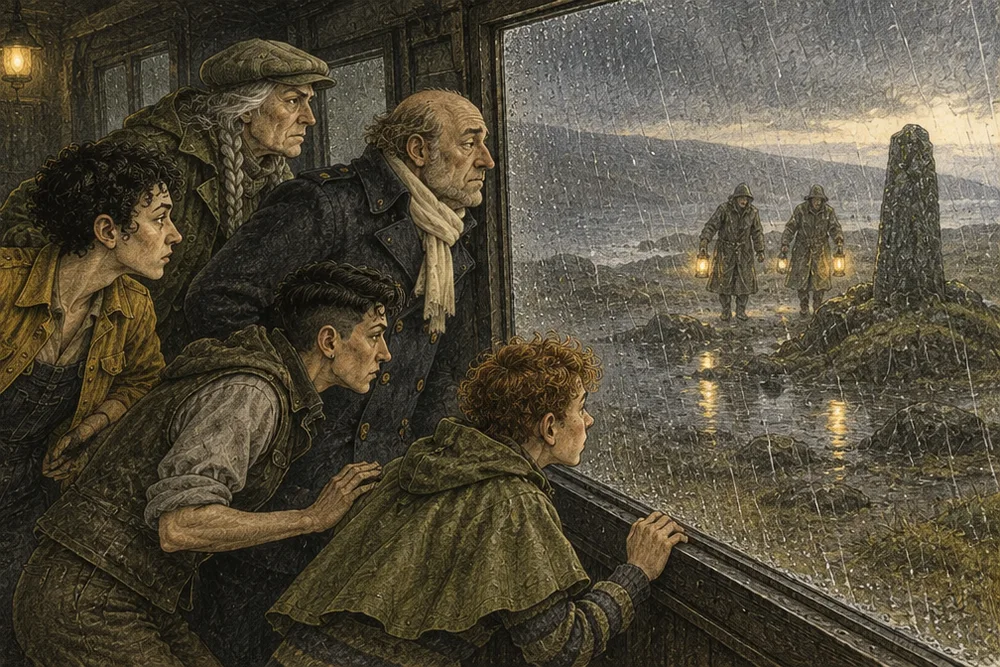
“Tell them we have not cleared the channel,” she said. “We’ll take one short movement to the marker, then inspect again.”
“That’s less than a hundred yards.”
“It’s the distance we can see.”
Toll relayed it. Dispatch’s response dissolved in static before the final word. The lamp at the far end of the coach flickered once, then steadied. The engine waited, warm and ready, while every passenger watched the same narrow strip of track.
The two observers returned to the shoulder before Inez eased the train forward. Their lamps remained visible ahead and to the left, never wandering beyond the line where the ballast dropped away. Inez released the brake and let the diesel set crawl at walking pace. The wheels rolled over wet stone with a low, careful clatter.
She stopped before the mile marker. The engine settled. Nobody cheered; the train had moved only a short length, and the dark channel remained beside them.
From the windows, the passengers compared the rail’s position with the post, then reported that it had not shifted. The observers checked the ground around the drainage cut from the shoulder. The timber lay in the channel, half-covered by water. Its end was wedged beneath grass, and its pale surface had made the false cross-track shadow. The rail and the visible ballast remained continuous at the point where they could see them.