Night Train for a Vanishing Town
Page 2 of 188
Chapters
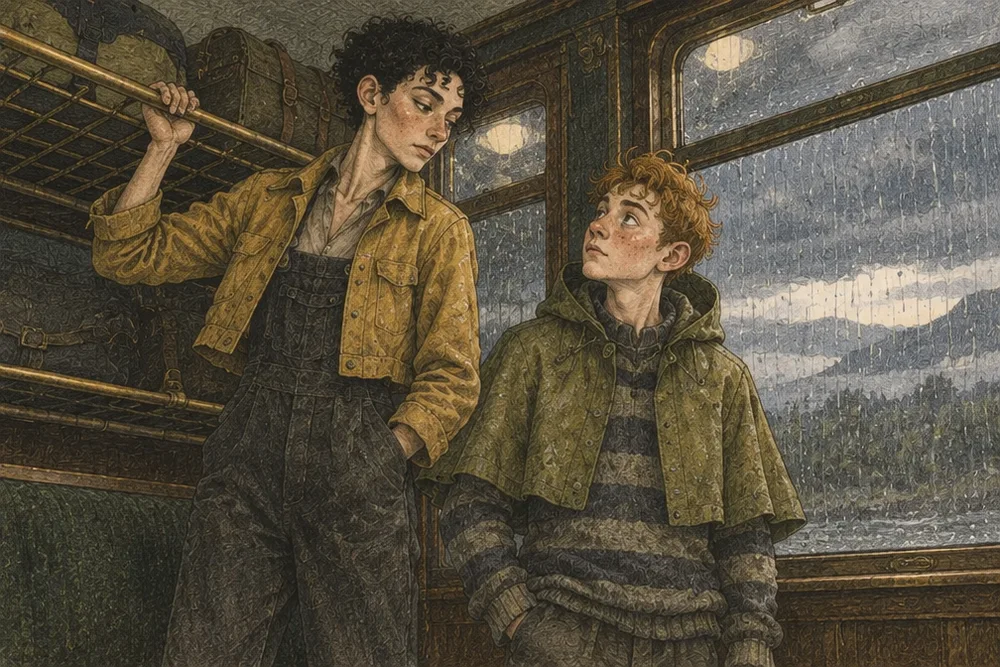
At the far end of the second coach, the boy stood beside the luggage rack with a rain cape hanging over an oversized striped sweater. He was lanky, all wrists and knees, and held a paper parcel under one arm. A rust-colored cowlick stood above his round face. When Inez stepped into the aisle to check the fire extinguisher seal, his eyes went to her hands, then her face.
“You’re taking us into Hushbank?” he asked.
“That’s what the board says.”
“I’m Kit Rusk. My dad’s working nights at the mine. He said if the river stayed down, I could come over and stay with him.” Kit’s gaze flicked toward the front of the train, where the windows showed only black hillside and brief smears of lamp. “Does his street still have a way to the station?”
Inez had the map in her mind: a narrow access road running from the lower terraces to the station approach, marked with a thin line. “There’s a path down from the low street,” she said. “It meets the station road. You’ll be able to find him.”
Kit’s shoulders eased. “Even after all that rain?”
“The map’s current,” Inez said, and knew even as she said it that the map was not current. It had been printed before the mine had shifted its boundary fence, before the town had argued about which lanes counted as streets and which were only tracks. She had seen no revision notice, but had also never seen the place itself.
“You know it, then.”
“I know the route.” The words came out too quickly. Kit nodded, accepting the certainty she had offered him, and returned to his seat. Inez went back to the cab with the taste of old paper in her mouth.
The line descended toward the river in a sequence of shallow curves. Each time the train rounded one, Hushbank showed itself in pieces: a spill of lamps on the far bank, a black ridge above it, the pale square of a mine office. Then the rain smeared the view away. Inez checked the route card in its metal holder, though she knew each printed instruction. Bridge approach: reduce speed. Confirm signal. Proceed on authority of route-qualified driver. The words seemed to have been made for someone other than her, somebody whose own face belonged beside the permit.
At 22:27 Toll came back into the cab with a paper movement log. He wrote the time, the weather, and the passenger count in a careful hand, then held the book against the console to keep it steady.