Night Train for a Vanishing Town
Page 182 of 188
Chapters
“Then you’ll have the wages for the hours worked and a copy of your training record. No debt to us.” He turned the form so she could read it. “Your employment ended after the inquiry. That decision stands. This is separate.”
Inez looked at her name. It did not resemble the one she had worn on the movement logs. There was no borrowed signature underneath it, no stamp making a lie look settled. She could not mistake the paper for forgiveness. It was a door that opened onto work she had not yet done.
“What happens if I make a mistake?” she asked.
“You report it. Someone checks it. If the mistake is serious, we stop the work and find out why.”
The answer was neither soft nor cruel. Inez read every clause, including the one about supervised access to the right-of-way. It was all ordinary: hours, safety rules, review dates, pay. She thought of the old inspection entry carrying her invented name, of the river shining in the cab lamps, and of how easy it had been to let a stamp stand in for a person’s judgment.
“I’ll take it,” she said. “Under my name. And I want the first field notes to include the drainage path beside the old saddle.”
The official nodded. “That’s reasonable. We’ll arrange the initial survey with Mara Sedge.”
Outside, Mara had arrived in her long olive raincoat and flat cap. Her silver braid lay against the collar. She stood with her knees softly bent, looking out beyond the fence rather than at the new platform. The years had not made her seem smaller; they had made her stillness more deliberate.
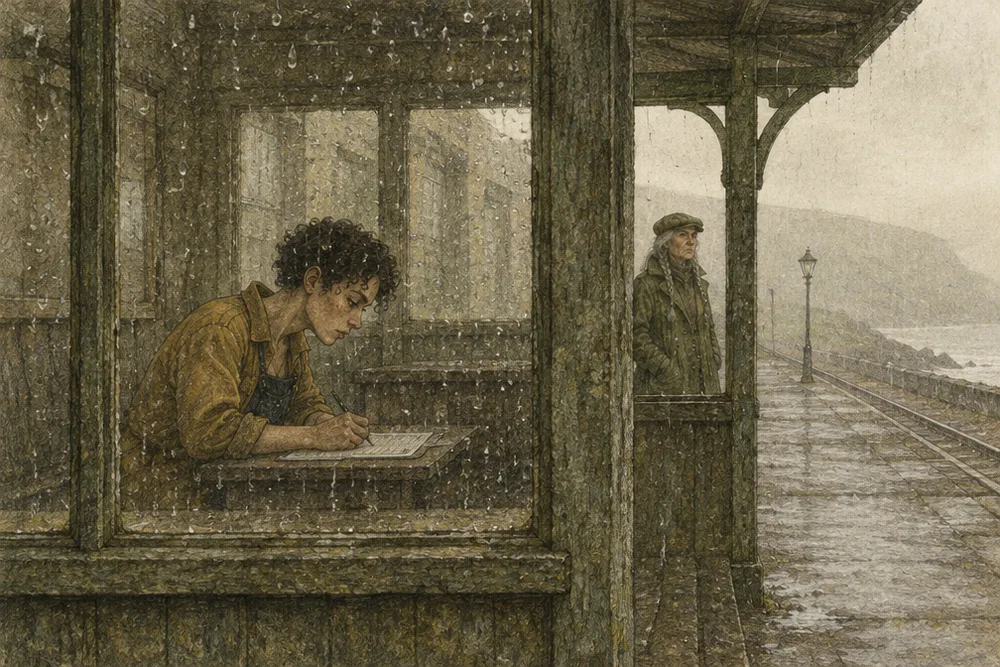
Inez took the pen from the case and signed where the line waited. The signature was unsteady at the first stroke and then grew firm. She passed the form back without covering the name.
Mara looked at the paper, then at Inez. “Survey work won’t make a cab yours.”
“I know.”
“And it won’t make that signature true.”
“I know that too.”
Mara gave a short nod. Not absolution. An acknowledgment that Inez had heard the terms. “Then we can start with the drainage.”
They stepped onto the platform as a breeze came up from the valley. It carried the smell of wet earth and something metallic from the rails. Behind the fence, the old town’s roofs formed a broken, uneven band among the pale scars of the flood. From this height, the terraces seemed close enough to reach. Inez knew how misleading that was. The road ended below the damaged slope; the station stairs were gone; no one could safely make a home of the streets that remained.