Night Train for a Vanishing Town
Page 17 of 188
Chapters
“They’re stuck?” Edda asked behind her.
“They’ve stopped.” Nessa turned back before the people could hear more in her answer than she knew. “That means they may still be able to come up to the spur. Keep the door clear.”
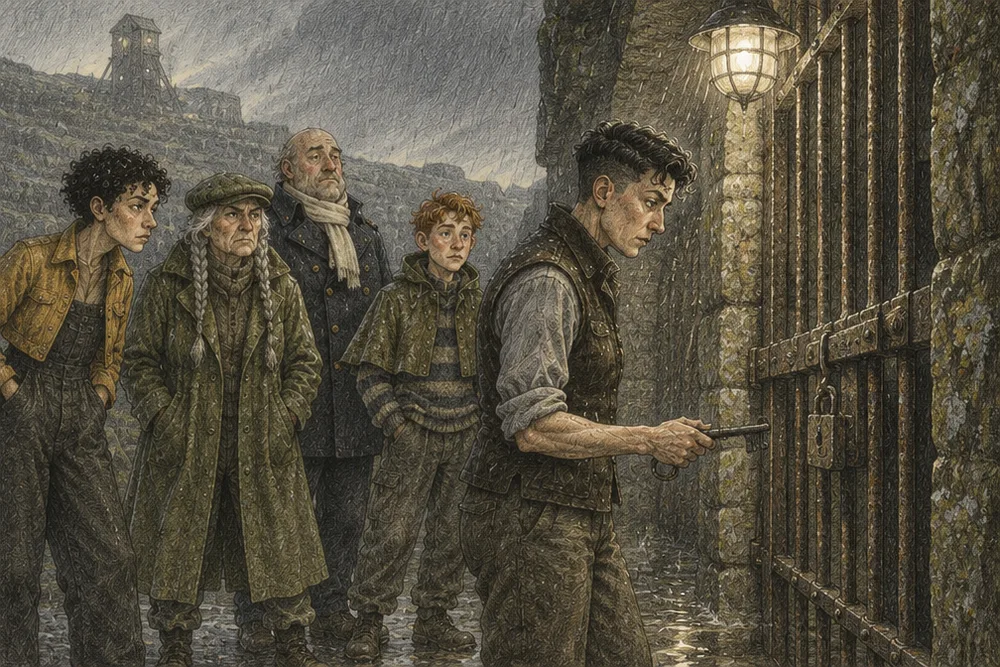
The spur gate stood below the lamp house, at the point where the town’s service track left the public road and climbed toward Slate Crown. Its iron bars were meant to keep ore carts away from the footpath. The lock was old, but the key was on the ring clipped to Nessa’s belt. The railway could send a train toward Hushbank; it could not make the town open a way through the terraces.
She had learned that distinction from years of managing pumps and flood gates. A machine might be capable of movement, and still have no right to move where it pleased. Water did not care about authority. People had to care on its behalf.
She called to Jory, the lamp-house caretaker, to stay with the count. “If anyone says the train is coming through, send them to me. Don’t open the gate.”
“Even if it’s the evacuation train?”
“Especially then. We don’t know who’s driving, what they’re bringing, or whether the track’s sound.” The last part came out sharper than she intended. She softened it. “We’ll find out before we let them onto the town spur.”
Jory nodded and tucked his pencil behind one ear. He was broad, nearly seventy, and wore his old pump-house keys on a chain around his neck. Nessa trusted him to keep a count. She did not trust anybody to mistake urgency for proof.
The handset crackled again. “Lamp house,” Nessa said at once.
This time the voice was farther away, muffled by interference. A woman asked if the town could hear. Nessa recognized neither the voice nor the call sign. “We can hear you. State your position.”
The reply broke into fragments: “...west of junction... main bridge gone... holding.” Then silence.
Nessa wrote it down as received, not confirmed. She had seen too many neat records become a reason to stop looking. She took a lantern from its hook and went to the covered passage leading down toward the gate. Jory called after her to be careful.
“I’m going as far as the lock,” she said. “No lower.”
At the end of the passage, the wind drove rain sideways across the stone steps. The town’s spur gate was visible beyond the railings, its top bar shining wet. She tested the key in her fist, then walked down far enough to see the path below it running black with runoff.