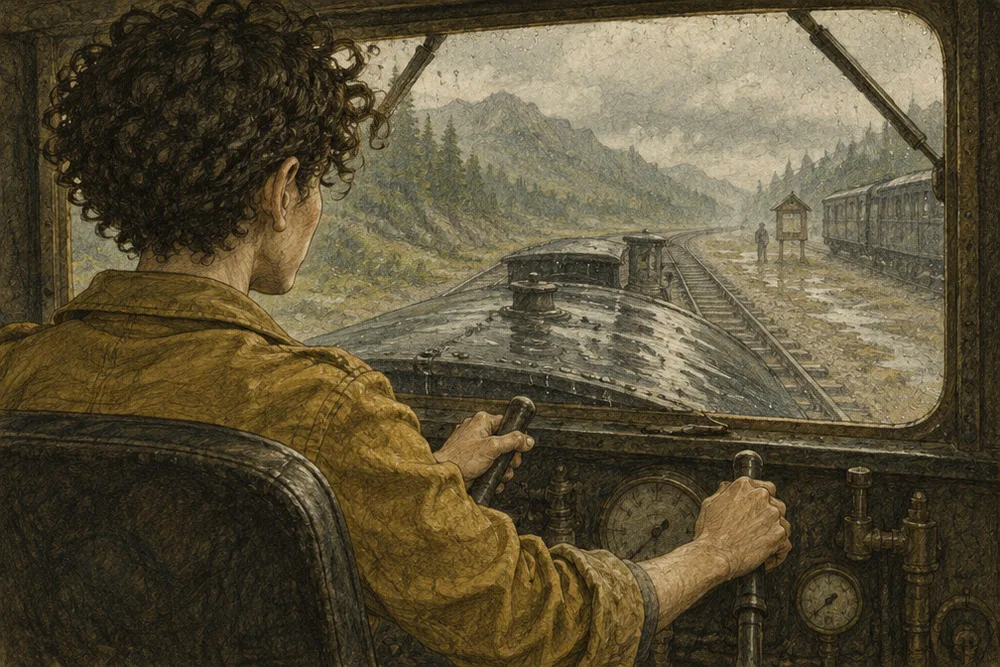
Night Train for a Vanishing Town
Page 147 of 188
Chapters
The relay’s nearest observer was an elderly woman from the front coach, Mrs. Pell, who had declined to climb the incline at Slate Crown and had declined again to walk any distance in the dark. She had devised the report board instead. Now she sat on the landing in a coach blanket, one boot braced against a wheel chock, watching the flooded drainage cut through a pair of field glasses borrowed from Kit Rusk.
“Rail line’s showing,” she called. “Cut’s still moving.”
The next observer, a broad-shouldered man in a wet cap, had a clearer angle from a low mound of stone. “It’s the cut that’s moving,” he called back. “The water’s sliding off the track.”
“That’s what I said.”
“You said it’s moving.”
Inez felt the urge to take the first sentence that sounded like permission and build a decision on it. She recognized the urge by its neatness. It wanted the train moving, the passengers reassured, and the night resolved into a clean line in the log. She knew how a clean line looked after the fact. A false inspection entry under Mara’s name had been clean, too, until Mara had put it in front of her.
“No guesswork,” she called. “Give me what you can see.”
The broad-shouldered man lifted his lamp. The light slid over the slope, broke into ripples, and found the ditch again. A clump of reeds spun in place at the mouth of the cut. Behind it, the rail seemed to stand above the water, but the shadow beneath its far side made the height difficult to judge.
From the board, Mrs. Pell called out measurements. She had marked the exposed rail against the signal post’s lower bolt and was comparing the waterline at intervals. The figures were small, shifting, and more useful than reassurance. The water had dropped two finger-widths since the previous reading. It had dropped almost three at the ditch mouth. The difference meant the channel was still carrying a current.
“Could be scouring the bank,” Toll said.
“Could be,” Inez answered. “Put that in the uncertain column.”
He glanced at her, then wrote it down. The pencil’s scratch was audible in the cab. She watched his hand form the words, careful and plain. It was a modest act, honest enough to feel like a correction to everything that had come before.