Night Train for a Vanishing Town
Page 140 of 188
Chapters
Mara walked along the train to speak with the observers at the far landing. The lamp swung at her side, a small moving island against the dark. Inez waited in the cab, keeping the brake set and watching the narrow track ahead. Behind her, the passengers took their places. The relay was forming again, not as a row of people on wet ballast, but as a chain of attention through warm, crowded coaches.
When the observers returned, their reports did not match. One saw a clean run across the arch; another had seen a dark break near the edge of the landing. The window watchers could not tell whether it was water, a shadow, or a gap in the ballast. Inez held the train where it was.
Mara came back to the cab. “The arch itself is standing. The landing needs another look from the side.”
“How long?”
“I don’t know.”
Inez appreciated the answer more than she wanted to. She sent a message to dispatch: train stopped before the arch, conflicting sight reports at landing, assessment continuing. Toll copied it into the log, then repeated it to confirm the radio had carried the whole sentence.
The waiting made the coaches feel smaller. Damp wool gave off a heavy, earthy smell. Heddle’s breathing was audible only when the train’s ventilation cycled quiet. Nessa stayed with her while a second passenger held the lamp near the bandage. The child had stopped crying and now slept with his mouth open, one fist tangled in his mother’s collar.
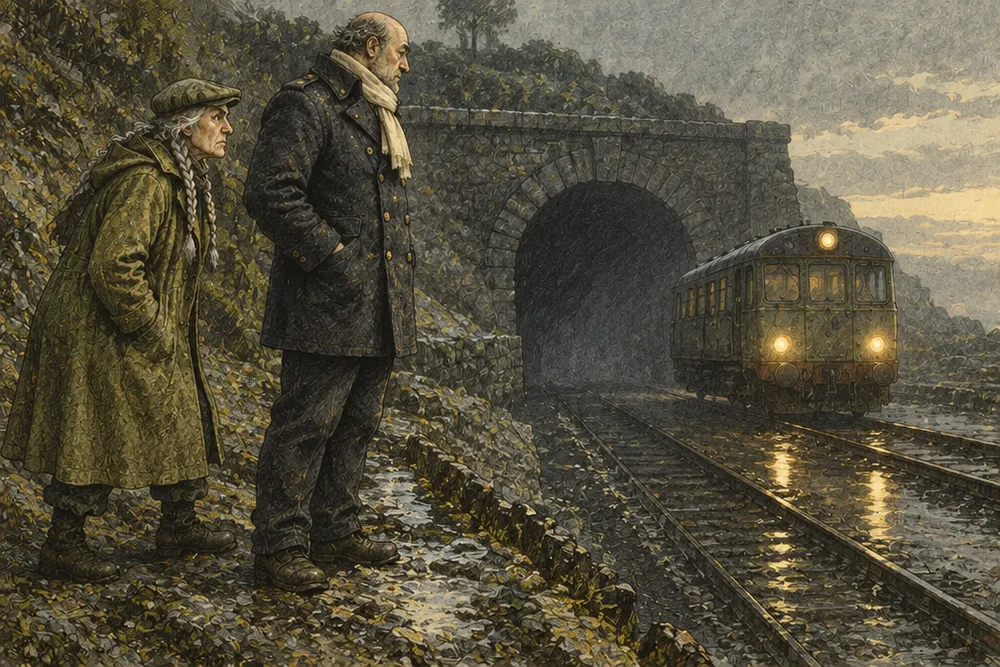
Inez watched the observers return to the landing in pairs. Their lamps moved separately, then converged. Someone pointed down. Someone else shook their head. A third stood back to check the angle. The relay had been designed to stop when the ground was uncertain, and now it was doing exactly that. Her chest remained tight all the same.
Mara leaned at the cab doorway, studying the dark line of the track. “The water has begun to drop,” she said, “but the current is cutting beside the rail.”
“Can the landing hold?”
“We’ll know when they tell us.”
Not when the water looked lower, not when the schedule demanded it, not when she wanted an answer. When they told us.
The observers came back with a clearer account. The dark break was a drainage path beside the railbed, gouged along the landing. They could see intact ballast beneath the nearest rail, but not enough of the far side to recommend movement. The report board remained blank for that section. No one tried to fill the space with an optimistic guess.