Night Train for a Vanishing Town
Page 124 of 188
Chapters
“Then we report what we see, not what we want.”
“That is what a driver is supposed to do.”
Nessa heard the weight in the word. Mara had never used her authority as a cudgel, but the town knew the railway had treated her signature as if it were a maintenance crew. Tonight she was not going to let a hopeful reading turn into another convenient fiction.
The radio hissed. Toll leaned close to it. “Dispatch, Slate Crown. We have three falling readings from the town pump house. Repeat, three falling readings. No railbed inspection yet. Train remains east of the saddle.”
A thin voice answered, breaking in and out. Toll wrote the time first. “Understood. Do not interpret a falling level as clearance. Await reports from both landings.”
“Fair enough,” Nessa said.
Toll’s shoulders eased by a fraction. “They may want a second set of numbers.”
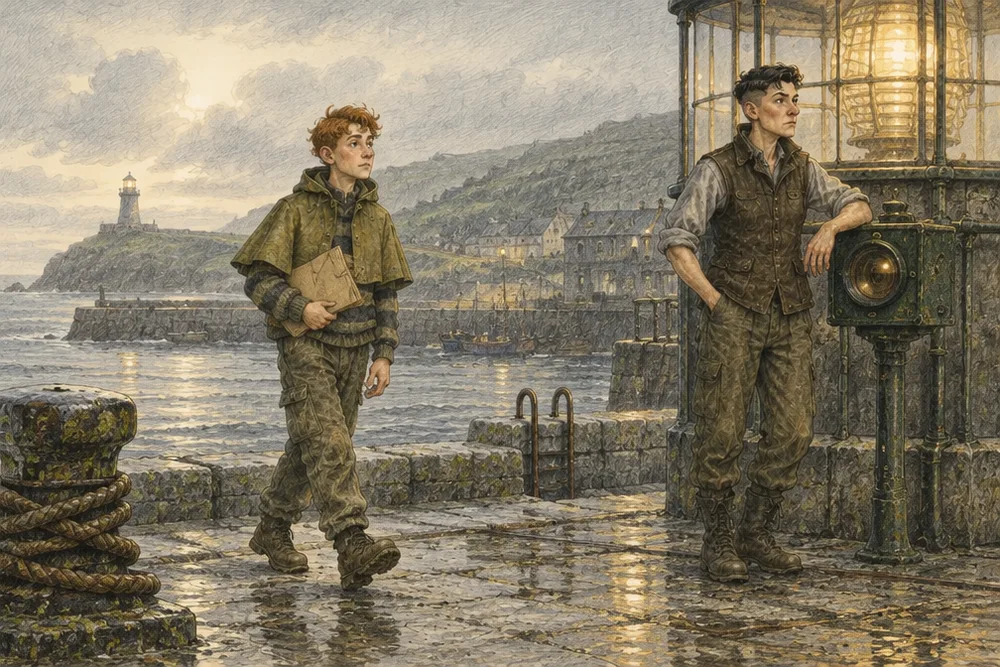
“They’ll get them.” Nessa looked around the room. The lamp-house signal sat on its stand by the stair door: a square lantern with a shutter that could be turned to send a clear signal down toward the shelf. The signal operator had gone below with the last group of residents and not returned. “Who’s on that?”
“Nobody,” Toll said. “I can take it.”
“You’ll need the radio and the log.”
Mara lifted her head. “I’ll stay by the diagram and call out anything the observers report.”
Nessa went to the board. There were names beside each task: count, relay, observation, treatment. She added the lamp-house signal and looked at the remaining residents. Some had already climbed aboard the train. Others were waiting for the final instruction, shoes dripping onto the floorboards. A woman with a splinted wrist raised her good hand.
“I can do the shutter,” she said. “I used to signal mine carts.”
“You know the pattern?”
“I know how to keep a lamp steady. Tell me what you need sent.”
Nessa handed her the signal card. “Acknowledge only what’s confirmed. No signal means no movement.”
The lamp-house signal was a small thing in a storm: a shutter, a flame, a pair of hands. Nessa had seen people in Hushbank make small things carry more weight than they were built for. A door bolt could decide which stair filled first. A name on a sheet could leave a family out in the rain. A mark on a wet wall could decide whether a train waited or moved.