Night Train for a Vanishing Town
Page 110 of 188
Chapters
“I’m sorry.”
“Don’t apologize in place of changing what happens next.”
Inez nodded. The instruction was clear. There was nothing she could say that would return the name to its rightful shape. Only the log, the wait, and the truth had any weight now.
Dispatch called again. A new gauge reading suggested the river might crest sooner than expected, but the figure had not been confirmed. “If the town’s count is not reconciled in fifteen minutes, you must assess whether you can depart with the people aboard,” the voice said. “We cannot authorize you to remain indefinitely.”
“Understood,” Inez replied.
Nessa climbed back onto the shelf. “The two people at the landing have found a third. He says the others went toward the old steps, but he means the steps by the ore bins.”
Kit was at the count board. “That’s not the way to the incline,” he said immediately. “The washhouse steps are the old steps. Ore-bin steps end at the closed yard.”
Nessa looked at him. “You’re sure?”
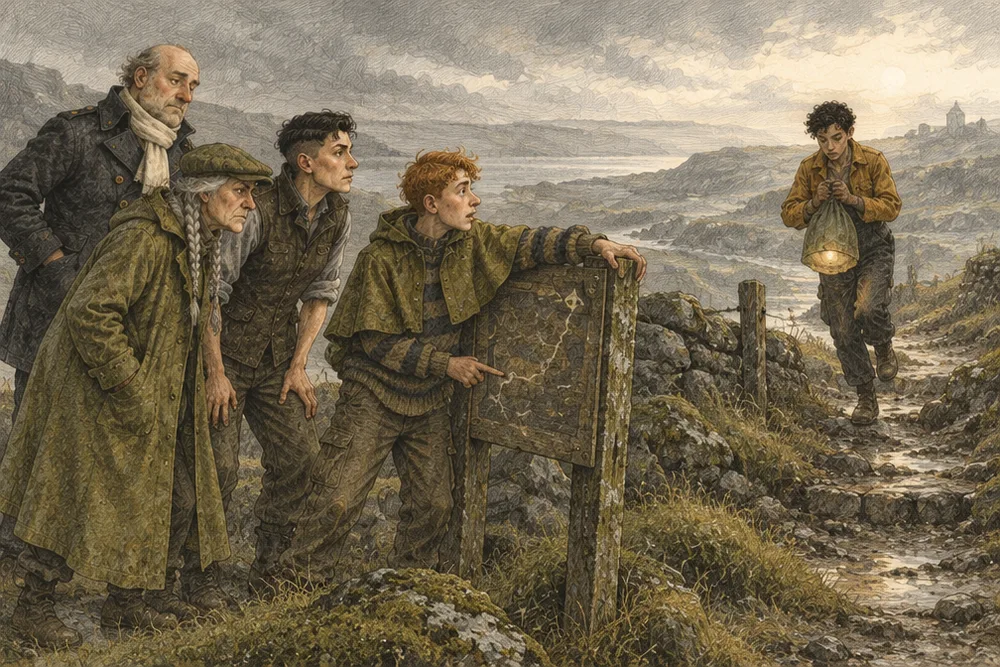
“My dad used to make me walk the washhouse path when I was little. He called the other ones the dead steps. They don’t go anywhere now.”
Nessa took the pencil and marked the board. “Then they’re checking the wrong place.” She turned toward the lamp house and shouted for a runner. “Tell them washhouse path. Not ore bins. The dry landing, then the incline.”
A runner took off down the shelf stair, followed by a second person carrying a covered lamp. Inez watched them vanish below the dark line of the platform. Kit kept one hand on the board, as though holding the names in place might keep them from being lost again.
“You knew the paths,” Inez said.
“I knew what my dad called them.” Kit’s gaze stayed on the dark. “It’s not the same as knowing where he is.”
No one contradicted him.
The truth of that settled over the people around the board. Knowledge could turn someone toward the right path. It could not tell them who would be waiting at the end of it. Inez had wanted the relay to make certainty possible, but its real gift was narrower: it kept them from pretending that an untested answer was a fact.
The wind shifted. Rain ran off the ore shelf in thin streams, drawing dark lines down the stone. A passenger near the rear coach called out that the lower lamp had moved, then stopped. Nessa lifted her hand for silence. They waited together, listening to the river and the faint clatter of a runner’s steps on the incline.