Ferry Receipts for Warnings Never Sent
Page 82 of 248
Chapters
“Anything?” the custodian asked.
“Not the count.”
“That’s often how it goes.”
Hester thanked him and went back to the desk, leaving the archive door to close behind her. She had found the place the records had been separated. She still had not found the page.
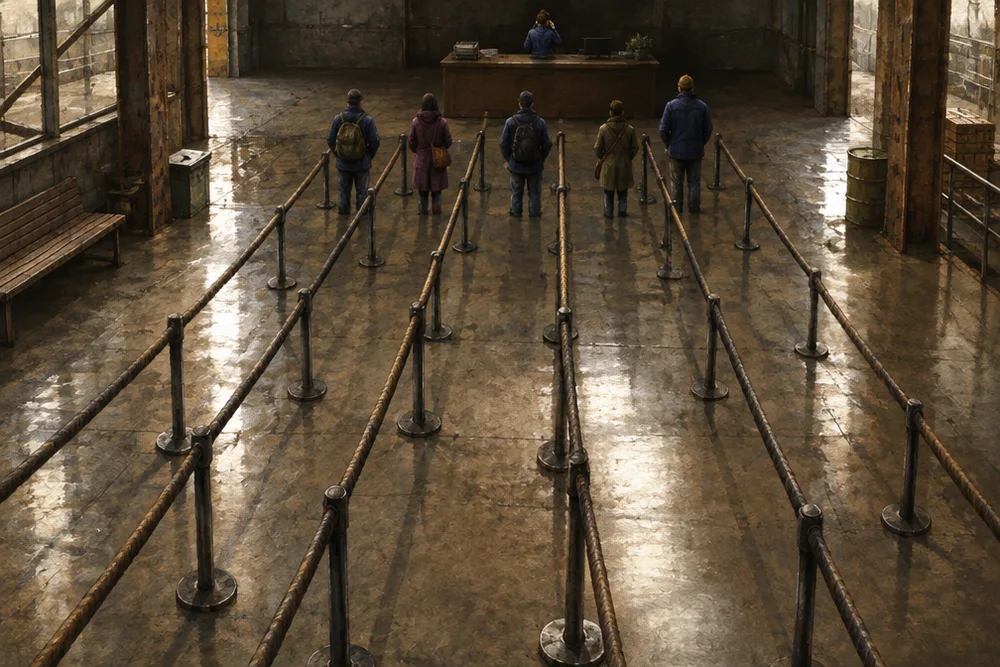
At the desk, the queue had doubled. Hester stood at her station and worked through it, leaving the archive search to the gaps between appointments. She gave people copies of their files, explained the appeal window, and wrote down questions she could not answer. One man asked whether an unsigned warning count could prove that he had declined help. Hester said she did not know. She no longer offered the phrase “the record shows” unless she could say what record she meant.
At lunch, she called Elías. The call rang twice before he answered.
“I’m trying to locate the yellow intake count,” she said. “The signed one.”
“The bed count?”
“The one with my initials and a diagonal stroke. It may have been on your clipboard.”
“I’m on shift. I can look after the noon crossing.”
“Could it have gone in the operations packet?”
“It could. When we were moving people, we stacked everything under the clipboard clip so it wouldn’t blow away.”
“Was the clipboard archived?”
“I remember a packet, but I don’t remember what was in it. I’ll check tonight.”
“There may be a triangular corner tear.”
“I’ll look.”
“And the heading should say what the count was for.”
He was quiet briefly. “If it was the sheet I’m thinking of, I remember people estimating who needed a bed. I don’t remember a heading.”
“You remember the count?”
“I remember the work. Not the words.”
Hester let the silence stay. Elías had already refused to turn his memory into a number, and she trusted him more for it. “I’m trying to reconcile it with the mattresses,” she said. “Thirty beds delivered. The shelter book shows thirty set up.”
“That sounds like a reconciliation.”
“It’s not proof.”
“Then don’t use it as proof.”
“I won’t.”
He exhaled. “Good. I’ll look.”
When the call ended, Hester returned to the queue. On the top of her notebook, she wrote: evidence of capacity is not evidence of persons. She underlined nothing. The thought felt like a rule she might need to keep herself from crossing another line.
The afternoon brought the second delivery of the day: a carton of replacement forms and a bundle of fresh white county printouts. The printouts were stacked in neat order, their boxed headings crisp. Hester sorted them by appeal number. Several refusal notices had been revised to include the phrase “recorded presence at address,” though the source field remained blank.