Ferry Receipts for Warnings Never Sent
Chapter 12 · Names on Separate Slips
Page 159 of 248
Chapters
The housing desk had no door, only rope lanes that could be unclipped and moved whenever the county needed another queue. That morning, Hester kept the rope clipped where it was. Beyond it, the terminal’s former baggage bay smelled of wet canvas, old salt, and the coffee someone had left cooling beside the public forms. The wall clock said eight twenty. Exhibit filing closed at noon.
Kit came through the side entrance carrying a shallow box against one hip. Their clay apron was still dusted with flour; a row of scalloped meal tokens clicked against the box’s rim. They set it on Hester’s counter without letting go. “These are the totals you asked for. Not names.”
Hester moved aside the white county printouts. “I asked for the totals, not the notes.”
“And I covered the notes.” Kit’s wide-set eyes stayed on Hester’s hands. “People came through the kitchen window because they needed food. They didn’t agree to have dinner turned into an address.”
Hester nodded. The refusal list had already made too much of what a mark could mean. “You can leave the box here. I won’t copy anything that identifies a person.” Kit released it, but did not step away. They waited until Hester opened the lid.
Inside were narrow tally sheets, their edges softened from handling, and a clean summary in Kit’s block printing. Separate columns counted meals sent by ferry runners and meals served to walk-ins. No household names appeared. In one margin Kit had written the number of portions packed for each run, then covered the original ledger notes with strips of blank paper fixed by tape.
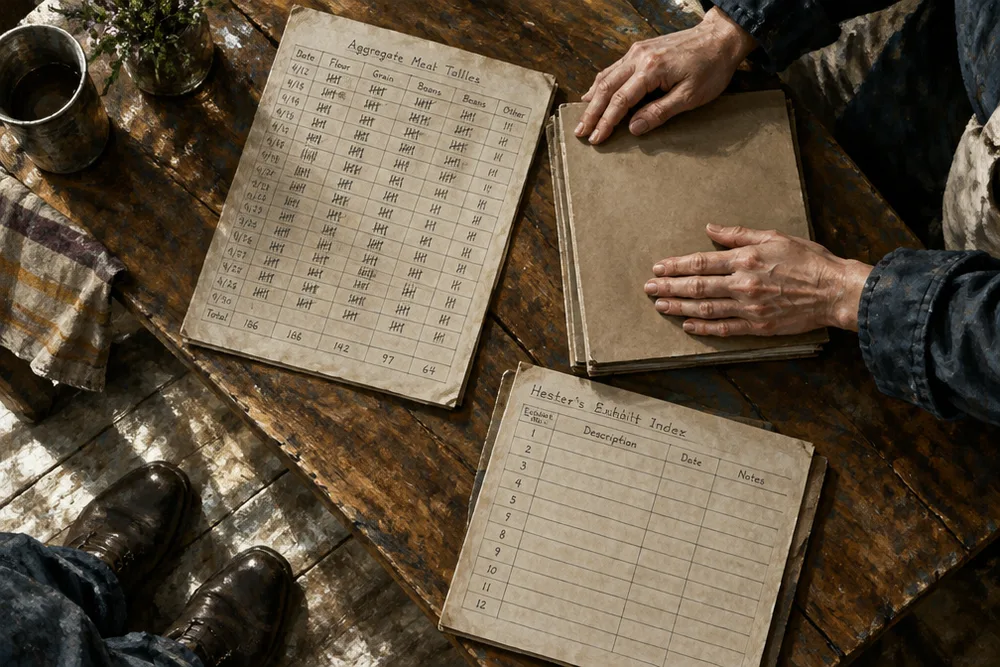
Hester read the columns twice. The runner totals matched the delivery counts Elías had brought her, close enough to support the same pattern without pretending the records were identical. Meals had gone aboard the Needle Ferry for people who were not booked in the terminal shelter. The kitchen had counted food, not residents.
“This helps,” Hester said. She kept her voice low. A man waiting across the rope lane leaned toward them, then looked down at his own appeal form. “It shows the ferry group was there.”
“It shows meals went out,” Kit corrected. “You want to say more, you’ll need somebody who saw more.”
“I know.” Hester placed the summary beside the draft exhibit index. “I’m not going to call a bowl a bed.”
Kit’s shoulders eased a fraction, then tightened again. “That sentence sounds easy here. Put it in a hearing room and somebody will ask who ate, where they slept, and what number they belonged under.”