A Small Fortune in Unclaimed Echoes
Page 77 of 186
Chapters
She began with the room’s perimeter, photographing each wall before coming close. The brickwork bore shallow screw holes in a neat horizontal line. A dark stain marked one corner where water had once seeped through; the timber there had dried and split, its grain raised like fine ridges. On the shelf lay a scatter of brittle paper scraps and a bent screw. Fenna did not move them.
She took a wide photograph of the threshold, then one from each corner. The witness held a scale beside the visible doorway but did not cross into the room again. Fenna recorded the dimensions in pencil, comparing the tape measure’s markings twice before she entered them. A few centimeters mattered when the question was whether a sound could have reached a microphone from one position and not another.
The cooperative witness held a small card at each doorway while Fenna recorded the room’s dimensions. The measurements agreed with the unaccounted bay she and Saira had found in the court. The plans had not simply omitted a closet. They had turned a usable room into solid masonry, erasing its door and the old route of the duct.
“My father drew this kind of arrangement,” Fenna said before she could stop herself.
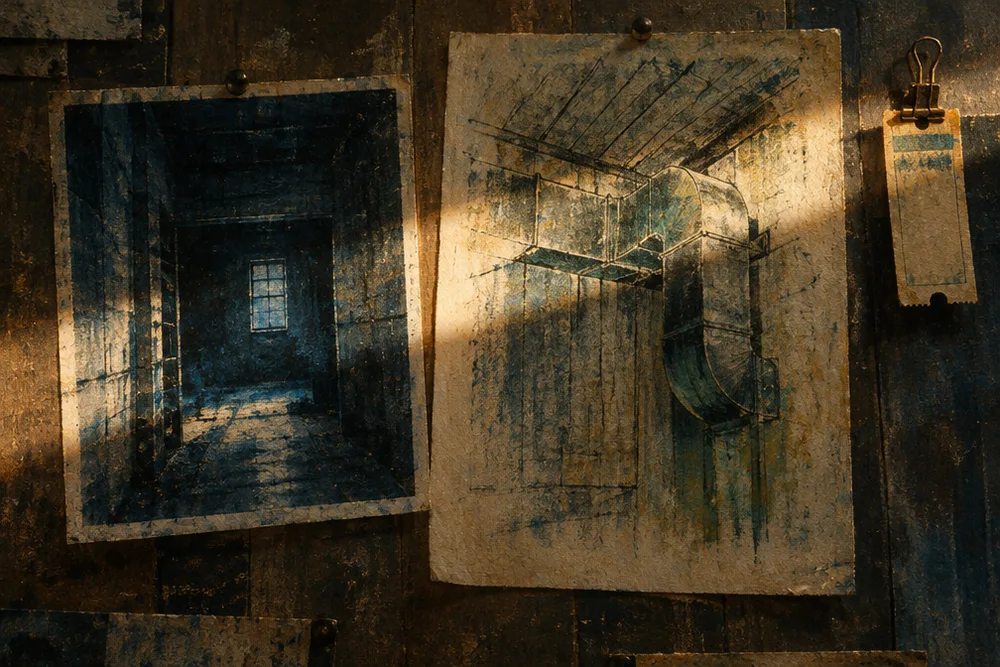
Saira glanced toward her. Fenna had told her that her father fitted the Exchange’s original acoustics, but she had never seen his drawings. Her father’s work had lived in stories and the occasional photograph: a ladder, a spool of wire, the back of a man in a work coat. She had kept away from the auction house’s papers for years, as if distance could keep his name from becoming another obligation.
The thought came with a familiar sting of embarrassment. She knew the practical vocabulary of his work—the difference between a listening duct and a speaking duct, the way a shallow return could be mistaken for an echo from the room itself—but she had learned it from other people. She had never asked him to show her the plans. When she was old enough to understand that he wanted to, she had already learned to pretend she did not care.
On the inner side of the door, a faint pencil mark sat above the latch. Fenna angled her headlamp across it. The mark resolved into two letters and a numeral: E.G. / 3. The graphite was protected by the door’s overlap, not faded by light. She took a close photograph.
The letters were small and slanted, almost hidden by the edge of the frame. The hooked E and open-topped G looked familiar in the way a voice does when heard through a wall. Fenna kept the light steady and made a second image with a ruler in frame. She did not touch the mark or rub the grain to see how deeply it had been made.