A Small Fortune in Unclaimed Echoes
Chapter 11 · Balance Carried Forward
Page 107 of 186
Chapters
The seller’s copy smelled of damp paper and iron gall. Fenna held it flat beneath two strips of inert glass while Saira Pell steadied the desk lamp, its amber pool catching the shallow dents where a clerk had pressed hard enough to score the sheet beneath. The receipt had turned up in a folder Ruth Dallow retrieved from a locked records drawer. Its rack number matched the ticket stub from the annex: 614. Its date matched the day the four speaking horns had entered the Cinder Exchange’s books.
“This is the part where I tell you what it says,” Fenna said, “and you tell me whether the accounts agree.” She leaned ear-first over the paper, though there was nothing to hear in it. Her long fingers traced the ruled columns without touching the ink. “One payment received. Four hundred and eighty pounds. Complete horn set, one lot. Collector: Amabel Vale.”
Saira’s broad stance shifted on the boards. In her ochre raincoat, she looked as if she had come straight from a roof inspection, which she had. “And that’s the whole amount?”
“The whole purchase price.” Fenna turned the sheet toward her. “There’s a separate line below it. Two hundred pounds held as a deposit against a second entry. Not received as payment for the horns. It says ‘pending confirmation of duplicate lot.’”
Saira read the line twice. Her wide-set eyes narrowed. “So the collector paid once, and somebody kept a second deposit because they thought there might be another set.”
“Or because the books said there was.” Fenna tapped the paper’s lower margin with a pencil. “The receipt doesn’t tell us where the deposit came from. But it separates the two sums. Ruth’s ledger made them look like two sales. This makes one purchase and one unresolved liability.”
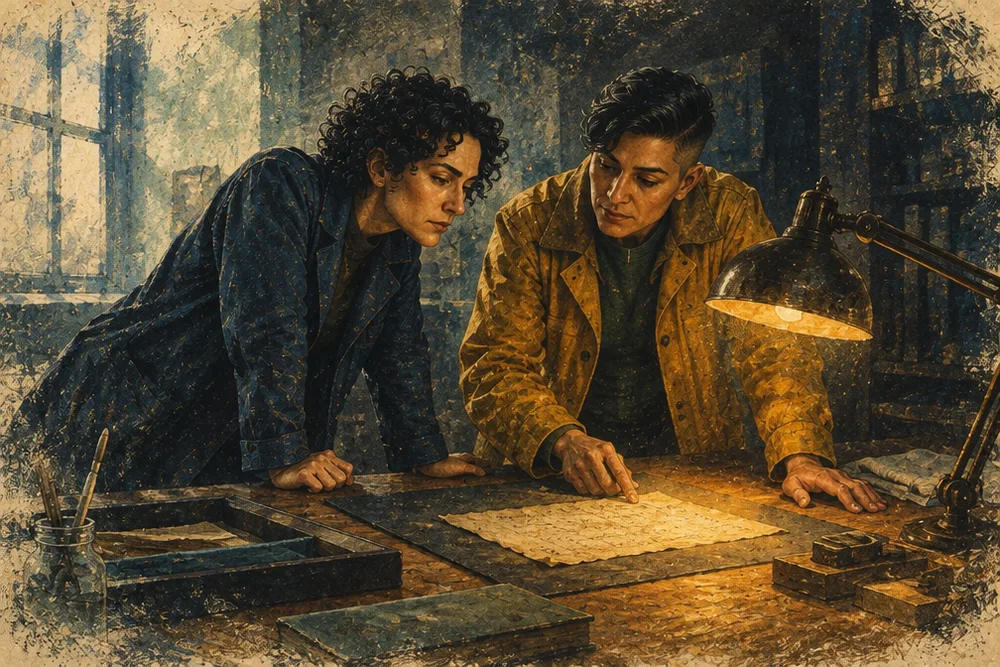
Saira pulled the lamp closer. The edge of her sleeve brushed the glass weight, and Fenna caught it before it shifted. She set it back with care. Paper could survive a century of careless hands and still fail in the instant someone tried to hurry it.
“The trust was owed the four-eighty,” Saira said. “And the two hundred belongs to whoever made that deposit.”
“If it was never returned.”
“It wasn’t.”
Fenna glanced at the account extract they had spread beside the receipt. A string of figures followed the same two amounts through the Exchange’s ledgers: sale proceeds entered, transferred to a dormant account, then carried forward under a broad heading for unclaimed balances. The handwriting changed over decades. The obligation did not. “We need to establish where the four hundred and eighty went. A receipt proves it was paid, not that the trust received it.”