A Small Fortune in Unclaimed Echoes
Page 2 of 186
Chapters
“The catalogue calls them a family,” Iona said. “The estate papers call them a set. The bidders are less patient with ambiguity.”
Four people waited nearby. A lanky young porter in a mustard vest leaned against a pillar, his knobby wrists hanging from his sleeves. A short, barrel-chested woman with a white braid sat upright on a chair, red gloves folded over a moss-green cape. A compact woman in an ochre raincoat stood with her boots planted wide. The last, a broad-faced man in a slate cardigan and silk scarf, rocked gently on his heels.
Iona named them without ceremony. “Milo Sedge, our porter. Ruth Dallow, retired from the Exchange. Saira Pell, treasurer of the cooperative across the court. Edwin Marr, the estate’s nephew.”
Milo’s gap-toothed smile appeared and vanished. Ruth’s hooked nose tilted up. Saira watched Iona rather than Fenna. Edwin’s eyes stayed on the horns.
“They all want a commitment before the sale,” Iona said. “Milo wants the brass withdrawn from the set. Mrs. Dallow wants the tin. Ms. Pell wants the mahogany. Mr. Marr says the papier-mâché horn is his family’s property. They insist each object has a separate history.”
“And the estate says otherwise?” Fenna asked.
“The estate inventory lists four horns together. The old ledger suggests they came through separate transactions. We have a duty to describe the lots accurately.”
Each of the four heard the phrase as a promise. Saira said she needed to know whether her bid could be protected from later challenge. Edwin wanted the sale completed before probate became more expensive. Ruth said the tin horn should never have been moved from its shelf. Milo said nothing about ownership; he asked whether a buyer could pay in instalments.
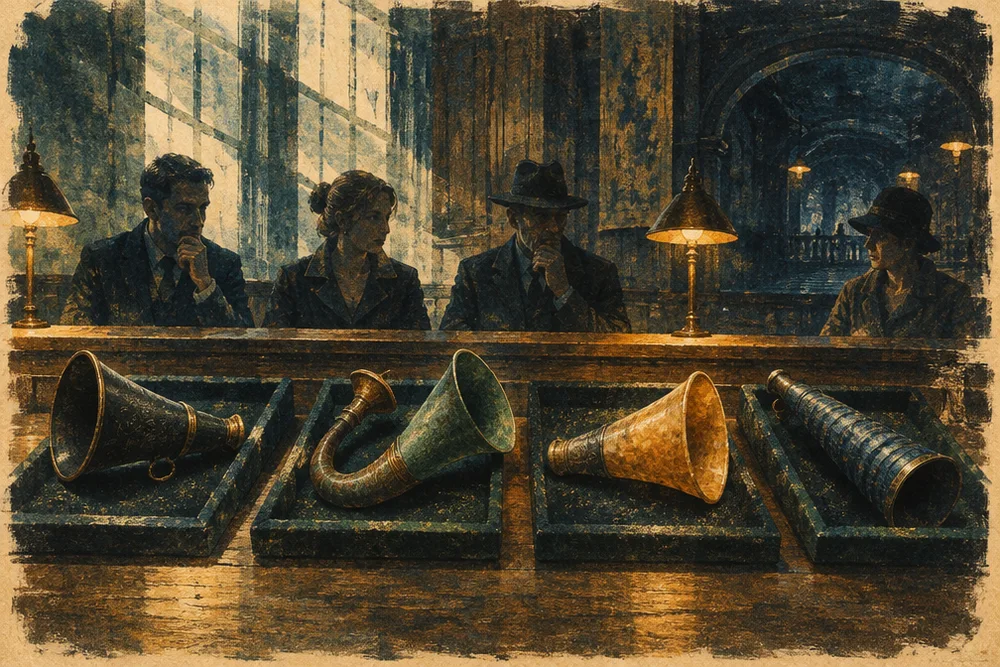
“No one is asking you to decide title,” Iona said. “Only to help us identify the voice on the recording. Once we have that, we can settle the description.”
“You said identify a voice,” Fenna replied. “Not settle four claims.”
“The recording may tell us what happened.” Iona held her gaze. “If it does, your report matters.”
The others were sent to the viewing gallery. Iona stayed beside Fenna as a young assistant carried up a shallow wooden case. Its brass hinges had darkened almost to black. A white cotton pad lay inside, and on it rested a brown wax cylinder no longer than Fenna’s hand. The surface was dulled but unbroken, its fine spiral ridges catching the window light in narrow amber lines.
“Found with the horns?” Fenna asked.
“In a drawer with their papers. The estate’s solicitor brought it yesterday.”
“Has it been played?”