A Small Fortune in Unclaimed Echoes
Page 104 of 186
Chapters
Saira had said the trust’s successor was the cooperative. That made the missing money more than a clerical curiosity. A dormant account could hold a claim long after a building changed hands and a clerk retired. Fenna wrote down the questions for an independent accountant: Was the purchase payment remitted to the trust? Where was the second deposit posted? Had it been refunded, transferred, or carried forward as an unpaid balance? Did the register’s duplicate sale produce any further payments?
She clipped the questions to the transfer-register photographs and sent a copy to the probate court with her condition report. Her wording was plain: The cylinder and contemporaneous documents are consistent with one completed sale of four horns. A second deposit appears to have been recorded against a duplicate entry. Payment history remains unverified. She attached the photographs and noted that the originals were held by Cinder Exchange.
The reply came back as an automated receipt. Fenna printed it and placed it in the cylinder’s file. Then she closed the case and checked the storage cabinet’s temperature. It held steady within the agreed range. Wax, paper, and ink each had their own ways of failing; she kept them separate, labeled, and supported. The truth of an old sale would require the same care.
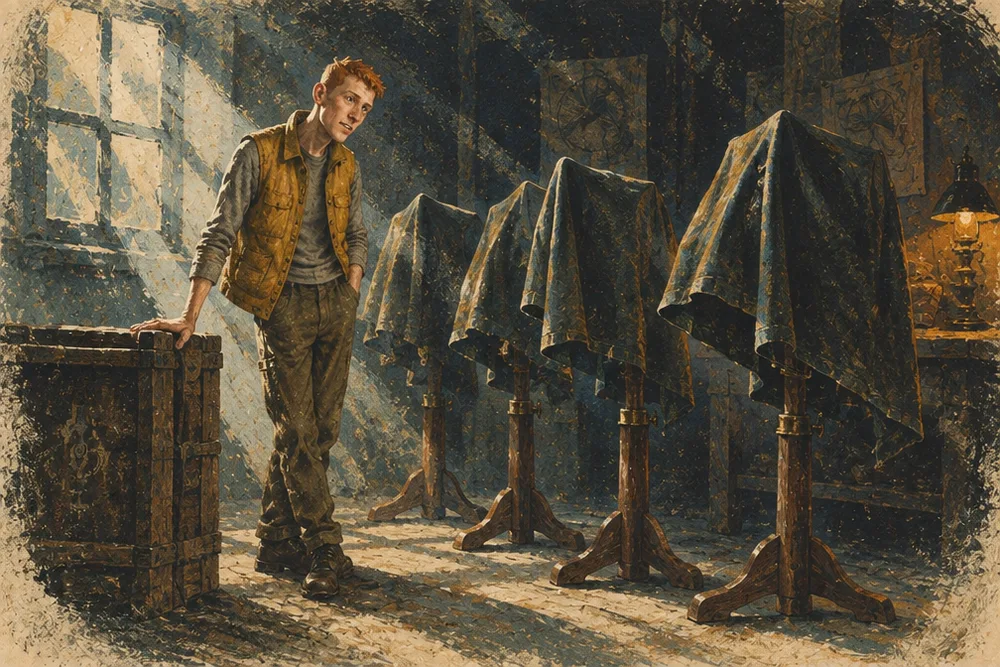
By the time Fenna reached the main auction room, the viewing period had ended. Staff were drawing covers over the four horns. The brass horn caught the overhead light in a dull green sheen; the tin one had a shallow crease along its bell; the mahogany horn’s grip was polished smooth; the papier-mâché shell showed a pale seam where an old repair had been made. The lot cards still named them separately.
Milo Sedge stood near the loading-court doors, mustard vest bright against the gray of his thermal. He had been carrying a crate, but now he held it against one hip and watched Fenna approach. “Did you find it?” he asked.
“We found the seller’s account and a receipt. It shows the set was sold together and paid for once. There’s also a later deposit on the duplicate entry.”